My first taxi in Istanbul took fifty minutes to cover four kilometres from Sultanahmet to Karaköy, because a bridge was up and the driver was, in fairness to him, as trapped as I was. The ferry from Eminönü to Karaköy takes seven minutes and costs less than a cup of coffee. The pier was a two-minute walk from where I had flagged the taxi down. It took me most of a week to properly absorb the lesson, which is that in this city the water is a road and the roads are not.
Getting around Istanbul means an Istanbulkart, which costs 165 TL and works on the tram, metro, ferries, funiculars and buses at 46.20 TL a ride and 34.40 TL for the first transfer. The T1 tram covers the old city, the M2 metro covers Beyoğlu, and the ferries are both the fastest and the most enjoyable way across the water.
What follows is every mode in the city, what each one costs since the İBB rise of 20 July 2026, which ones a visitor will actually use, the routes worth memorising, the taxi rules that protect you, and the mistakes that cost people an hour a day. All fares checked on 10 September 2026 at €1 ≈ 56 TL.
Istanbul transport fares, September 2026
The İBB raised fares on 20 July 2026, the second rise of the year after February. These are the current figures, checked on 10 September 2026 at €1 ≈ 56 TL, $1 ≈ 48 TL and £1 ≈ 65 TL. Expect another rise in early 2027 — this is the one table on this site most likely to be out of date first.
| Item | Price | Notes |
|---|---|---|
| Istanbulkart (anonymous) | 165 TL | Non-refundable; holds up to 2,750 TL; shareable by up to 5 people |
| Standard ride | 46.20 TL | Tram, metro, bus, funicular, Marmaray, most ferries |
| First transfer | 34.40 TL | Within a set window; further transfers are cheaper again |
| Student ride | 22.55 TL | Requires a registered student card |
| Single-use ticket | 65 TL | Also 120 TL for 2, 275 for 5, 530 for 10 |
| Metrobüs | 33.08–68.59 TL | Priced by number of stops |
| Mavi Kart (monthly) | 3,628 TL | Unlimited; only worth it for residents |
| Ferry: Beşiktaş–Kadıköy | 59.28 TL | 7 June 2026 tariff |
| Ferry: Kabataş–Kadıköy | 57.00 TL | |
| Ferry: Üsküdar–Eminönü | 53.20 TL | The classic crossing |
| Ferry: Kabataş–Princes’ Islands | 137.48 TL | Student 68.76, over-65 96.23; no transfer discount |
| Taxi flag (yellow) | 71.94 TL | UKOME decision of 17 July 2026 |
| Taxi per km (yellow) | 47.92 TL | Minimum fare 230 TL |
| Taxi (turquoise / black) | 75.21 / 111.18 flag | 50.09 and 74.05 per km; minimums 240 and 360 TL |
| Taxi waiting time | ~10 TL per minute | |
| Sea taxi | ~420 TL per trip | On demand, point to point |
There is no night tariff in Istanbul. The taxi rate is the same at three in the morning as at three in the afternoon. Any driver who tells you otherwise is inventing it, and it is the most common attempt made on visitors here.
The Istanbulkart, and why you need one immediately
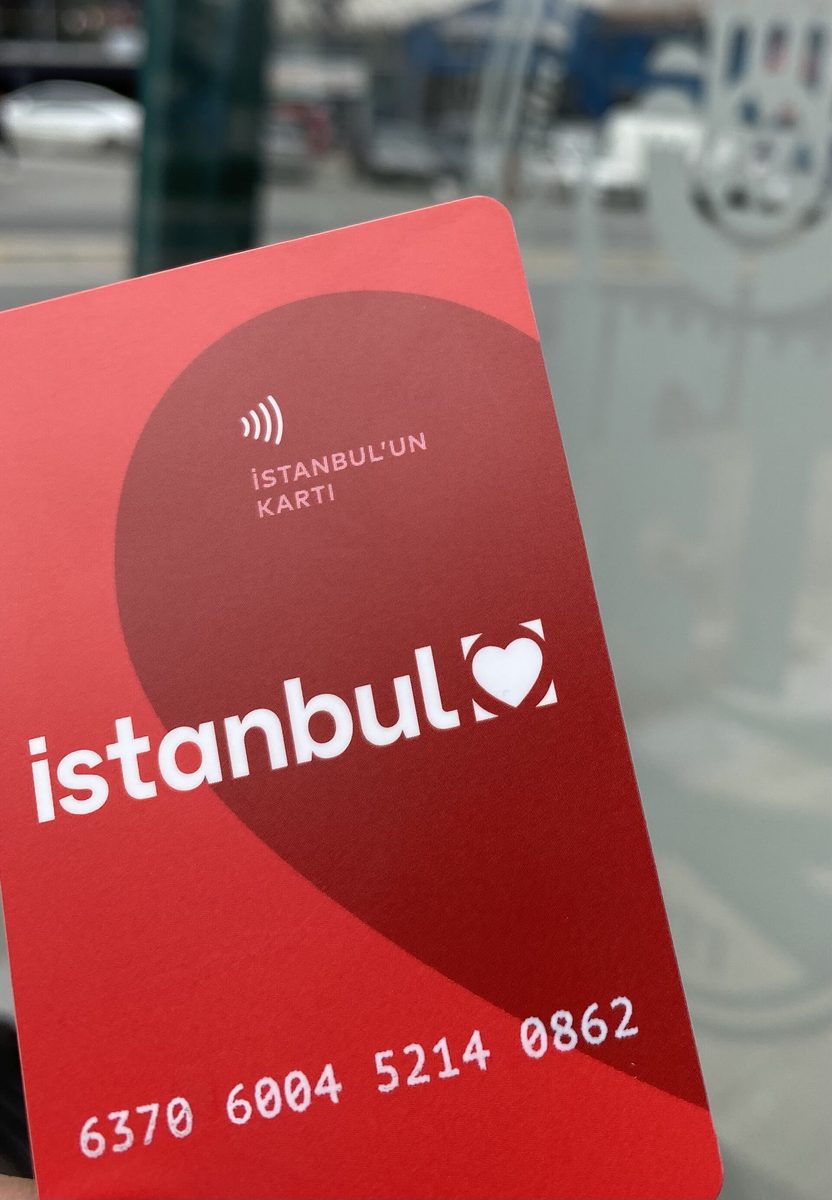
An anonymous Istanbulkart costs 165 TL from a machine — the yellow biletmatik kiosks at every metro and tram station, at both airports and at ferry piers. The 165 TL is the card, not credit, and it is not refundable. Load it with cash or a card at the same machine; the maximum balance is 2,750 TL.
The two things that make it worth buying within ten minutes of arriving. First, a ride costs 46.20 TL on the card against 65 TL for a single-use ticket, so it repays itself in about four journeys. Second, one card can be tapped for up to five people, which means a family needs one card, not five — tap, pass it back, tap again.
Transfers are discounted: your first transfer within the window costs 34.40 TL rather than the full fare, and subsequent ones less again. This makes the metro-plus-tram journeys that look expensive on paper considerably cheaper in practice. The discount applies on Bosphorus ferry routes but not on the Princes’ Islands services.
Contactless bank cards now work at ferry gates and on much of the network, which is convenient for a single journey and worse value than the card for anything more. There are also registered personal Istanbulkarts, which is a bureaucratic process aimed at residents and not worth a visitor’s time.
The tram, which is the line you will use most
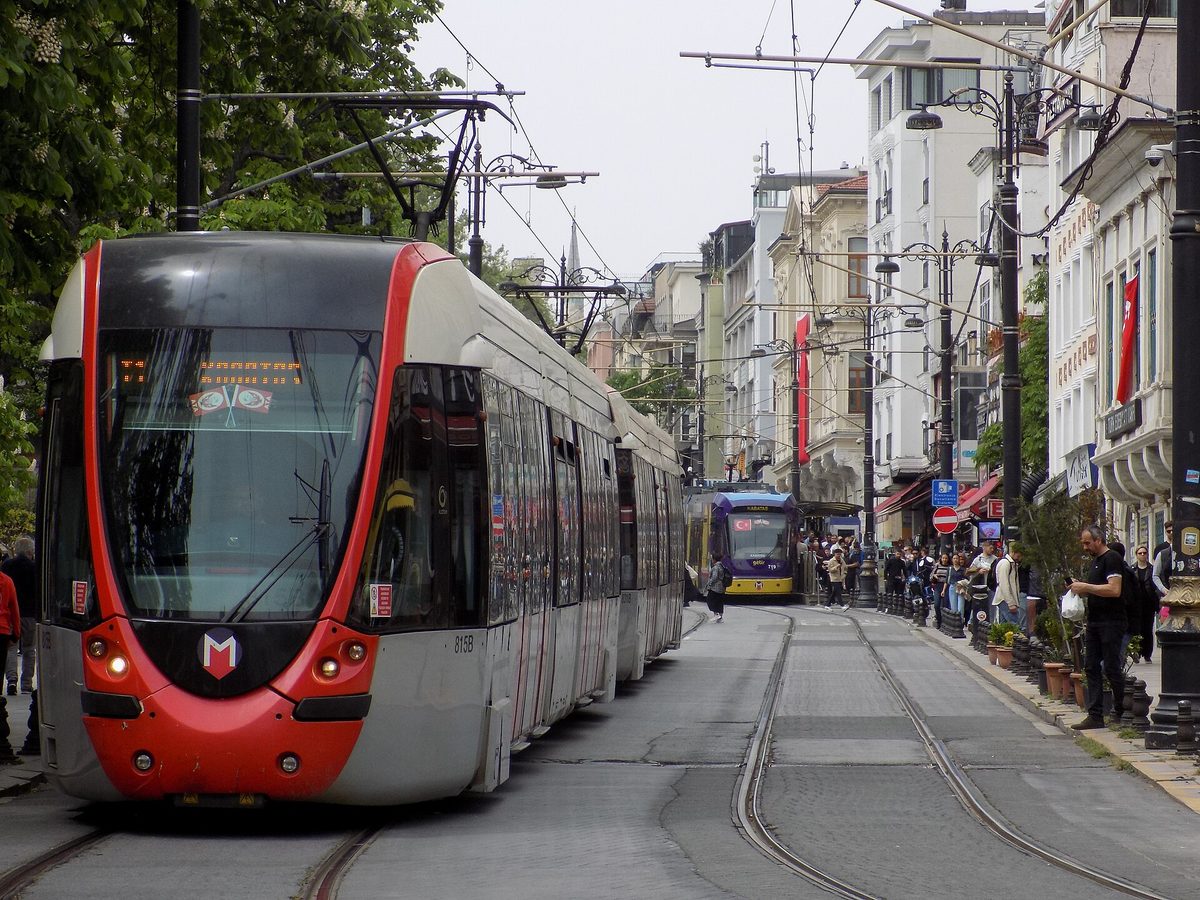
T1 Kabataş–Bağcılar is the visitor’s line and it is almost embarrassingly convenient. Running east to west through the parts of the city you came to see, its useful stops are Kabataş (for the funicular to Taksim and the island ferries), Tophane (Istanbul Modern), Karaköy (ferries, Galataport, the Galata hill), Eminönü (Spice Bazaar, ferries, the balık ekmek boats), Sirkeci (Marmaray), Gülhane (Topkapı’s outer gate), Sultanahmet (Hagia Sophia, the Blue Mosque, the cistern), Çemberlitaş (the hamam) and Beyazıt-Kapalıçarşı (the Grand Bazaar).
Trams run every five to ten minutes from about six in the morning until midnight. They are crowded at rush hour and in the middle of the day in summer, and there is no way round it. Tap in at the barrier on the platform, not on board.
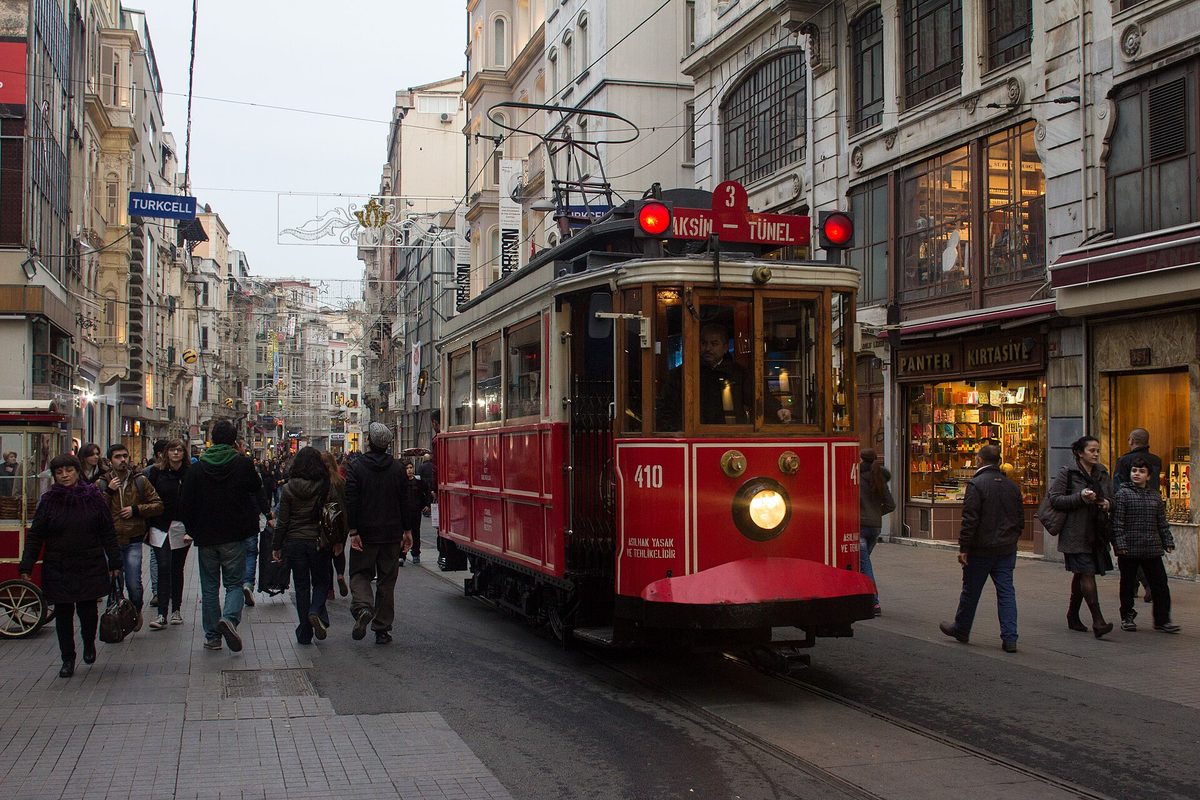
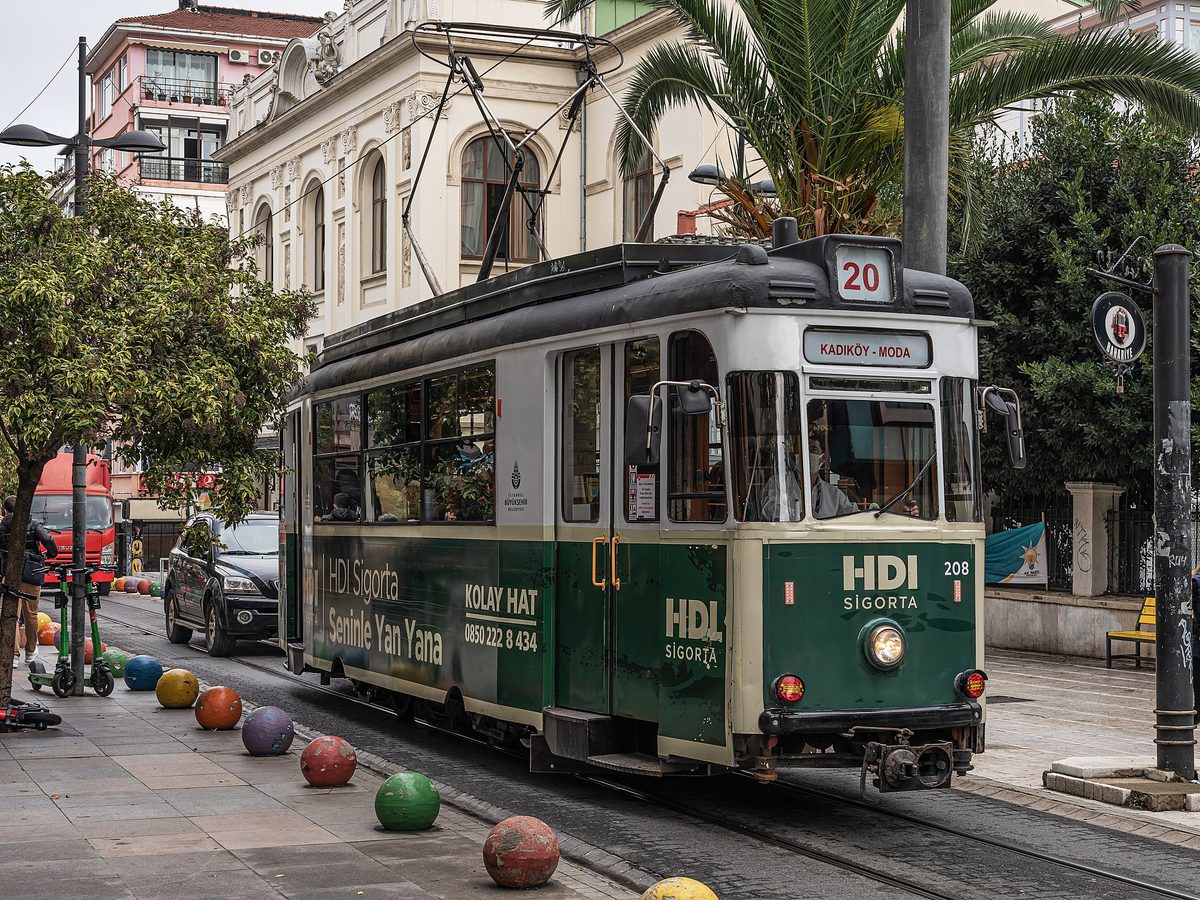
T3 Kadıköy–Moda is a nostalgic tram that loops through Moda on the Asian side. T2 is the red heritage tram up İstiklal from Tünel to Taksim, which is charming, frequently full, and slower than walking. Both are experiences rather than transport, and both take a standard fare.
The metro
Istanbul’s metro is modern, clean, fast and expanding constantly — new lines and extensions open often enough that a two-year-old map is unreliable. Trains run roughly 06:00 to midnight, with limited all-night service on some lines at weekends.
M2 Yenikapı–Hacıosman is the one visitors use: Vezneciler for the Grand Bazaar and Süleymaniye, Haliç crossing the Golden Horn on its own bridge, Şişhane for Galata, Taksim, Osmanbey for Nişantaşı, Levent and Maslak for the business districts. It connects to the M11 airport line at Gayrettepe.
M1 runs from Yenikapı out to the Otogar coach station and beyond. M4 runs down the Asian side from Kadıköy to Sabiha Gökçen airport, 23 stations in 52 minutes. M11 is the Istanbul Airport line, reaching Gayrettepe in about thirty minutes and Halkalı in the other direction. M7 crosses the Golden Horn to Kağıthane and connects the M2 to the Asian side via a Bosphorus tunnel.
The one thing to know about metro interchanges here: some are long. The Gayrettepe connection between M11 and M2 involves about eleven minutes of walking, which matters a great deal with luggage.
Marmaray, the tunnel under the Bosphorus
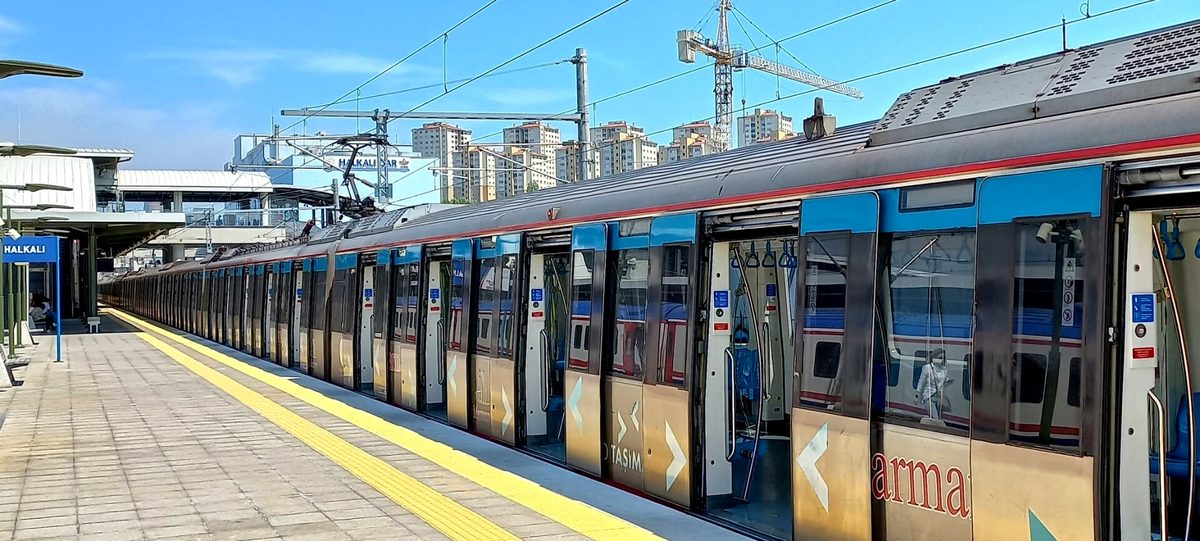
Marmaray is a commuter rail line running from Halkalı in the far west, under the Bosphorus, to Gebze in the far east — 43 stations, standard fares, and the tunnel section opened in 2013. For visitors, the useful stops are Sirkeci, Yenikapı, Üsküdar and Ayrılık Çeşmesi, and it is the answer whenever you need to cross the water and the ferries have stopped or the weather has closed them.
It also connects to the high-speed rail network: services to Ankara and Konya run from Halkalı, Bakırköy, Söğütlüçeşme and Pendik. Haydarpaşa, the grand Asian terminus, is closed and has been for years, so do not plan a train around it.
Trains are frequent — every ten to fifteen minutes — and full at rush hour. Tapping through with an Istanbulkart works exactly as it does on the metro.
The ferries, which are the point of the whole system

Istanbul has one of the world’s great urban ferry networks and it is priced as ordinary public transport. Şehir Hatları is the municipal operator; Turyol, Dentur Avrasya and Mavi Marmara run competing services on some routes; İDO runs fast catamarans across the Marmara.
The crossings worth knowing: Eminönü–Kadıköy and Eminönü–Üsküdar from the old city; Karaköy–Kadıköy and Karaköy–Üsküdar from Galata; Kabataş–Kadıköy and Beşiktaş–Kadıköy from the Bosphorus shore; Beşiktaş–Üsküdar as the short hop. All take twenty minutes or so, all run every fifteen to thirty minutes through the day, and all cost 53–60 TL on the card.
Longer routes: the Golden Horn line from Üsküdar and Karaköy up to Eyüp, stopping at Fener and Balat, which is the sensible way to reach those neighbourhoods; the Kabataş–Princes’ Islands service at 137.48 TL; and the Üsküdar–Anadolu Kavağı line up the Asian shore of the strait at standard fares.
Practicalities. Tap at the gate on the way in. There is tea and simit on board. The upper deck at the stern is the place to stand. Ferries stop around midnight, earlier on some routes, which is worth checking if you are eating on the far side. And a strong northerly wind can suspend the longer services at short notice between November and March, though the short crossings almost always run.
Funiculars, cable cars and the two-minute railway
F1 Taksim–Kabataş connects the T1 tram at Kabataş to Taksim Square and the M2, saving a steep climb. Standard fare, every few minutes.
Tünel, from Karaköy to the bottom of İstiklal, is the second-oldest underground urban railway in the world after London’s, opened in 1875. It takes ninety seconds and climbs a hill that is genuinely unpleasant on foot. Standard fare, and a bargain for the history alone.
The Eyüp–Pierre Loti cable car lifts you from the Golden Horn shore to the café on the hill above the cemetery, with the best Golden Horn view in the city at the top. Standard fare. There is a second cable car at Maçka.
Buses, metrobüs and dolmuş
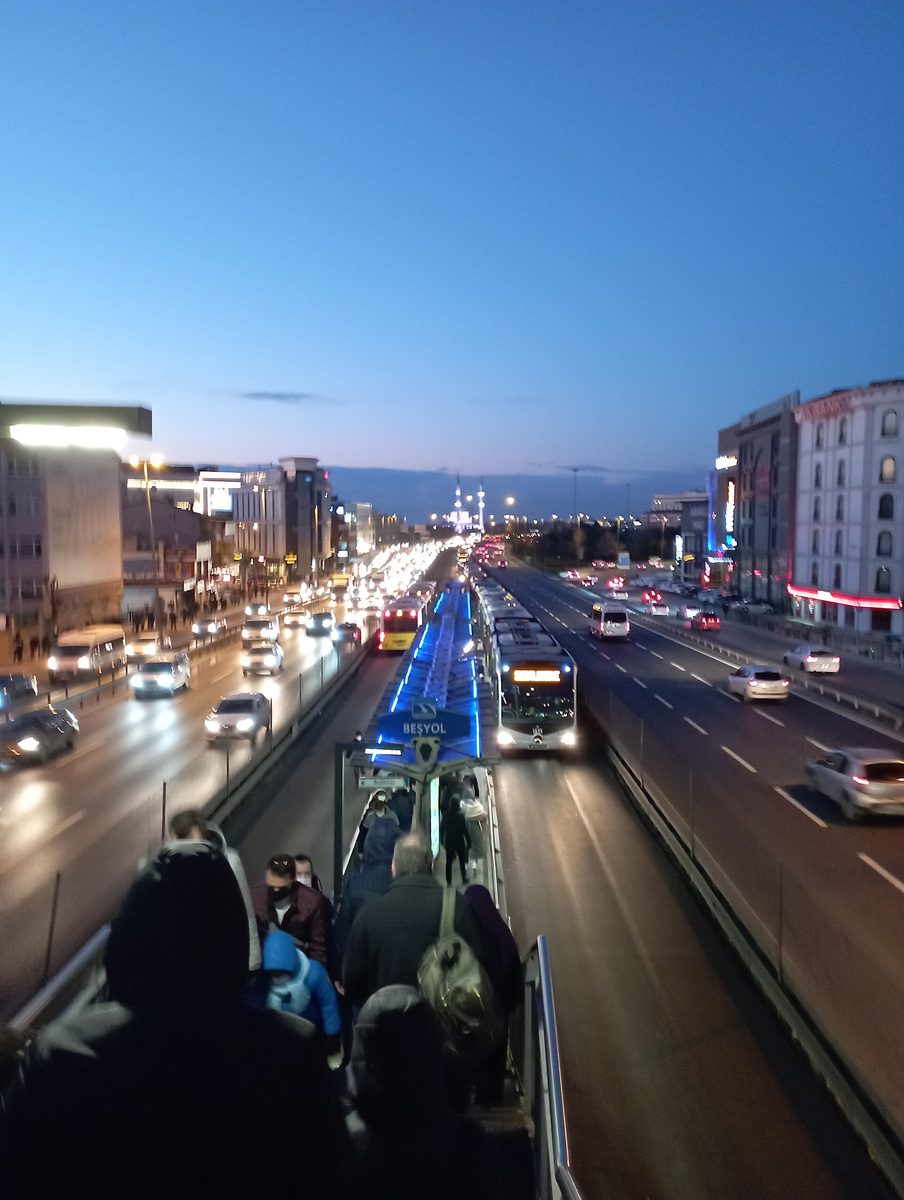
City buses cover everywhere the rail network does not — the Bosphorus coast road, the outer neighbourhoods, Belgrade Forest. They are cheap and they are hostage to traffic. Use them for the shore road north of Beşiktaş, where there is no alternative, and for reaching Balat and Fener if the ferry timetable does not suit.
The metrobüs is a bus rapid transit line running in a segregated lane down the middle of the E5 motorway, crossing the Bosphorus bridge, from Beylikdüzü in the far west to Söğütlüçeşme on the Asian side. It is priced by distance at 33.08–68.59 TL and it is astonishingly efficient and astonishingly crowded. Visitors rarely need it; if you do, it is the fastest way across the city at rush hour by a wide margin.
Dolmuş are shared minibuses running fixed routes, leaving when full, paying cash to the driver with change passed along the row. They are a genuinely useful survival of an older system on routes like Kadıköy–Bostancı and Taksim–Beşiktaş. You will need a little Turkish and a lot of confidence about where to get off — say “inecek var” when you want to stop.
Taxis and ride apps
The tariff, again, because it is the thing worth memorising: yellow taxis start at 71.94 TL and charge 47.92 TL per kilometre with a 230 TL minimum fare. Turquoise cabs are 75.21 and 50.09 with a 240 TL minimum; the eight-seat yellow vans are 85.02 and 56.63 with a 270 minimum; black cabs are 111.18 and 74.05 with a 360 TL minimum. Waiting time runs about 10 TL a minute. All from the UKOME decision of 17 July 2026.
Tolls are passed on and legitimately so: about 59 TL for the Bosphorus bridges, 95 TL for the Yavuz Sultan Selim bridge and around 280 TL for the Eurasia Tunnel. A cross-continent trip should include one of these on the bill.
Use the app. BiTaksi and Uber both operate here and both dispatch licensed yellow taxis, which removes the two problems at once: the fare is metered and recorded, and the refusal to take a short fare mostly disappears. Hailing on the street works, but insist on the meter — “taksimetre, lütfen” — before setting off, and get out if the answer is a fixed price.
Sample fares to calibrate against: Sultanahmet to Taksim about 312 TL, Sultanahmet to Galata about 359 TL. If a driver quotes you €30 for either, you now know what to say.
Sea taxis exist at around 420 TL a trip and are a genuine option when the bridges are solid and you need to be across the water at a particular time.
Routes worth memorising
A handful of journeys come up again and again on a visitor’s week. These are the versions that work.
Sultanahmet to Taksim. T1 tram to Kabataş, then the F1 funicular up. About twenty-five minutes and two taps. A taxi is roughly 312 TL and, at the wrong hour, slower.
Sultanahmet to Kadıköy. Tram one stop to Eminönü, then the ferry. Forty minutes door to door, most of it on the water, and about 100 TL. Do not take a taxi across a bridge for this.
Beyoğlu to the old city. Walk down through Galata to Karaköy and either cross the bridge on foot — fifteen minutes, and worth doing at least once — or pick up the tram. The Tünel funicular saves the climb on the way back.
Anywhere to Balat and Fener. The Golden Horn ferry from Karaköy or Üsküdar, getting off at Fener or Ayvansaray. Slower than a taxi and considerably more pleasant, and it solves the neighbourhood’s one real weakness.
Old city to Chora (Kariye Mosque). There is no direct rail. A taxi is about twenty minutes and the simplest answer; alternatively the T5 tram along the Golden Horn to Ayvansaray and a short uphill walk.
Kabataş to the Princes’ Islands. Ferry, about ninety minutes to Büyükada at 137.48 TL, or from Bostancı on the Asian side in about thirty. Weekdays only if you can help it.
Taksim to the Bosphorus villages. Bus down the coast road from Beşiktaş or Kabataş, or ferry to Ortaköy and Bebek where services run. The coast road is beautiful and unpredictable in equal measure.
Apps, maps and paying
Three things worth having on your phone before the first journey.
A journey planner. Google Maps handles Istanbul’s public transport well, including ferry times, and Moovit is a reasonable alternative. The İBB’s own apps exist and are less pleasant to use in English. Where all of them fall down is walking gradients and the length of some metro interchanges, so pad the estimates.
BiTaksi or Uber for taxis. Both dispatch licensed yellow cabs with the meter running and a record of the trip, which removes the two things that go wrong with a street hail.
An offline map of the neighbourhoods you are staying in. Phone signal is generally good, but the Grand Bazaar in particular is a dead zone and a labyrinth, and this is where people get genuinely lost.
On paying: keep the Istanbulkart somewhere you can reach without unpacking, because the barriers are busy and the people behind you are commuters. Top it up before it runs out rather than at a barrier — the machines take a moment and there is always a queue at rush hour. And check the balance on the reader when you tap; it displays the remaining credit.
Walking, and where it works
Istanbul is a superb walking city in patches and a punishing one between them. Within Sultanahmet, within Galata and Beyoğlu, along the Bosphorus shore at Bebek, and around Kadıköy and Moda, walking is far and away the best way to see anything.
Between those areas it is a different proposition. The peninsula is built on seven hills, the pavements are cobbled and often narrow, and pedestrian crossings are a negotiation rather than a right of way. Add a third to any walking time your phone gives you. Take the tram uphill and walk down.
The walks genuinely worth doing: across Galata Bridge on the lower deck; from Karaköy up through Galata to İstiklal, if your knees permit; the length of İstiklal itself; the Bebek to Rumeli Hisarı waterfront; and the Salacak promenade in Üsküdar at sunset.
Renting a car, a scooter or a bike
Do not rent a car in Istanbul. This is the one piece of transport advice here I would give without qualification. The traffic is heavy and assertive, lane discipline is aspirational, parking in the historic districts is close to impossible and expensive where it exists, and every place a visitor wants to go is better served by rail or water. A car makes sense only if you are leaving the city — for Şile, the Black Sea coast or a longer Turkish road trip — and even then, collect it on the way out rather than keeping it parked for three days.
If you do drive: the bridges and the Eurasia Tunnel are tolled electronically through the HGS system, and a hire car should come with a transponder — confirm it, because the fines for passing without one are a nuisance to resolve from abroad. Fuel is expensive by regional standards. And the coastal roads that look like a scenic option on a map are the same roads the whole city commutes on.
Scooters and bicycles are a limited proposition. There are shared e-scooters in parts of the city and İSBİKE docking stations, but the hills, the traffic and the near-total absence of protected lanes make cycling in the centre a specialist activity. The exceptions are genuinely good: the Bosphorus shore path between Bebek and Rumeli Hisarı, the Golden Horn cycleway, the Caddebostan seafront on the Asian side, and the Princes’ Islands, which are car-free and where bikes rent for around 100 TL an hour.
Safety, etiquette and small courtesies
Istanbul’s public transport is safe, well used at all hours and policed. The realistic risks are pickpocketing on crowded trams and in the bazaar quarter, which is opportunistic rather than organised, and the ordinary business of being squashed at rush hour.
A few conventions worth knowing. Seats near the doors are set aside for elderly and pregnant passengers and people do actually give them up, quickly and without discussion. On the ferries, the seats facing the view fill first and nobody minds you standing at the rail instead. On buses and the metro, let people off before boarding — a rule observed here rather more reliably than in some European cities.
Women travelling alone will find the network entirely usable at any reasonable hour; the metro and tram are busy and well lit, and there is no separate women’s carriage. Late at night, a taxi ordered through an app is the sensible default anywhere.
Two small things that make life easier: learn “inecek var” for the dolmuş, and keep 20 and 50 lira notes for the ones that take cash, because nobody has change for a 500.
Accessibility
The picture is mixed and worth knowing in advance. The metro and Marmaray are modern and generally step-free with lifts at most stations. Ferry piers are largely level and boarding is usually straightforward. Trams have level boarding at platforms.
Against that: the old city’s cobbles and gradients are difficult, many older buildings and small hotels have no lift, pavements are frequently obstructed, and the historic sites vary enormously — Topkapı is spread over a large site with gravel and steps, while Dolmabahçe and the Archaeology Museums are comparatively flat inside. If mobility is a consideration, build the day around the tram, the metro and the ferries, and treat any long walk between them as a decision rather than a default.
Getting around Istanbul: the mistakes that cost people an hour a day
Taking a taxi across the water at rush hour. Between four and eight on a weekday, the ferry and the metro will both beat a car across the Bosphorus, often by half an hour or more.
Not buying an Istanbulkart on day one. Single tickets at 65 TL a ride add up fast, and the transfer discount is where the real saving is.
Assuming a phone map’s walking time. It does not know about the hill, the crowd on İstiklal or the fact that the pavement disappears for sixty metres.
Ignoring the ferries because they look like an excursion. They are commuter transport, they are frequently the fastest route, and they are the best part of the day.
Booking a hotel more than fifteen minutes from a tram, metro or ferry. The single most expensive decision available, paid in time, every day of the trip.
Accepting a fixed price from a street taxi. The meter is almost always cheaper, and the apps remove the argument entirely.
Frequently asked questions
What is the best way to get around Istanbul?
An Istanbulkart used on the T1 tram, the M2 metro and the ferries. Those three cover almost everything a visitor wants, they are immune to traffic, and a journey costs 46.20 TL with the first transfer at 34.40 TL. Taxis are for late nights, heavy luggage and journeys the network genuinely does not serve.
How much is an Istanbulkart?
165 TL for the anonymous card, which is the price of the card itself and not credit, and it is non-refundable. Load it at the same machine; the balance can go up to 2,750 TL. One card can be tapped for up to five people.
How much is a single journey in Istanbul?
46.20 TL on an Istanbulkart since the fare rise of 20 July 2026, with the first transfer at 34.40 TL. Without a card, a single-use ticket is 65 TL. Ferries across the Bosphorus are 53.20–59.28 TL, and the Princes’ Islands service is 137.48 TL.
Is Istanbul’s public transport easy for tourists?
Yes, more so than most people expect. Signage is bilingual, the tram and metro maps are simple, the machines have an English option and the network reaches almost everything on a standard itinerary. The two complications are the length of some metro interchanges and the fact that new lines open often enough that older maps mislead.
Do taxis in Istanbul rip off tourists?
Some try. The defences are simple: use BiTaksi or Uber so the meter runs and the trip is recorded, insist on the meter if you hail on the street, know that there is no night tariff, and know roughly what a route costs — Sultanahmet to Taksim is about 312 TL. Tolls on the bridges and the Eurasia Tunnel are legitimate additions.
Can I use contactless cards on Istanbul transport?
At ferry gates and on much of the network, yes. It is convenient for one journey and poorer value than an Istanbulkart for anything more, since you lose the transfer discount and pay closer to the single-ticket rate.
What time does Istanbul transport stop?
The metro, tram and Marmaray run from about 06:00 to midnight, with limited all-night services on some metro lines at weekends. Ferries stop around midnight and earlier on the longer routes. Night buses cover the gaps, and taxis run 24 hours at the same tariff as daytime.
How do I get from the European to the Asian side?
By ferry, which takes about twenty minutes and is the pleasant option; by Marmaray, which takes about five minutes under the water and is the fast one; by metro on the M7’s Bosphorus crossing; or by road over a bridge, which at rush hour is the slowest of the four by a considerable margin.
Is the metrobüs worth using as a visitor?
Rarely. It runs down a motorway rather than through anywhere you want to see, and it is crowded to a degree that surprises people. Its one use is speed across the whole city at rush hour, when nothing else comes close.
Do I need a car in Istanbul?
No, and renting one is close to a mistake. Traffic is heavy, parking in the historic districts is scarce and expensive, and everywhere a visitor wants to go is better reached by tram, metro or ferry. Rent a car only if you are leaving the city, and collect it on the way out rather than paying to park it.
How do I get to the Princes’ Islands?
By ferry from Kabataş, Eminönü, Kadıköy or Bostancı. Kabataş to Büyükada is about ninety minutes at 137.48 TL; Bostancı on the Asian side is about thirty and much the quicker option if you are staying that side. Island fares do not get the transfer discount. Go on a weekday if you can — at weekends these boats carry Istanbul rather than visitors.
Are there luggage restrictions on the tram and metro?
No formal ones, and the metro and Marmaray have space. The T1 tram at rush hour with two large cases is unpleasant for you and for everybody else; if you are moving hotels, do it in the middle of the day or take a taxi.
Is Istanbul walkable?
Within neighbourhoods, very. Between them, no — the hills, the cobbles and the water make it hard work. The best approach is to walk each area thoroughly and use the tram, metro and ferries for the joins, which is also how the city itself moves.
The card, the fares and the lines are only half of it — the other half is knowing that there is no night taxi tariff, that the Basilica Cistern refuses cash, and that the ATM’s offer to bill you in your own currency costs 4–8%. Those sit with the rest of our practical advice for first-time visitors to Istanbul, priced and dated.
The ferries are not just transport: at 53–60 TL a crossing they are the cheapest twenty minutes of sightseeing in Istanbul, and they land you somewhere genuinely different. Our guide to Kadıköy, Moda, Üsküdar and Çamlıca sets out which pier to sail from and what to do when you get off.
Related Istanbul guides
- Getting in from the airport is a separate problem with its own answers — see Istanbul airport to the city centre.
- Every plan in our Istanbul itineraries for one to seven days is built around the tram and the ferries rather than taxis.
- Hotel choice and transport are the same decision — see where to stay in Istanbul.
- The ferries deserve a day of their own: our Bosphorus cruise guide compares the public boats with the tourist ones.
Photo credits
- T1 tram in Istanbul (featured image) — photo by Zach1055, Wikimedia Commons, CC BY-SA 4.0.
- An Istanbulkart — photo by Sharon Hahn Darlin, Wikimedia Commons, CC BY 2.0.
- İstiklal Avenue nostalgic tram — photo by Alexey Komarov, Wikimedia Commons, CC BY 3.0.
- Marmaray train at Halkalı — photo by Josef Moser, Wikimedia Commons, CC BY-SA 4.0.
- Şehir Hatları ferry — photo by Mark Ahsmann, Wikimedia Commons, CC BY-SA 3.0.
- Metrobüs corridor — photo by DaniyalAliRaja, Wikimedia Commons, CC BY-SA 4.0.
- Nostalgic tram in Moda — photo by A.Savin, Wikimedia Commons, FAL.
Fares checked on 10 September 2026, after the İBB rise of 20 July 2026 and against the Şehir Hatları tariff of 7 June 2026, converted at €1 ≈ 56 TL, $1 ≈ 48 TL and £1 ≈ 65 TL. Istanbul has raised transport fares in February and July in recent years, so expect these figures to move — check metro.istanbul and sehirhatlari.istanbul if the exact number matters to your budget.