Neighbourhoods ·
Beyoglu Istanbul Guide: Taksim, Istiklal, Galata, Karakoy & the Neighbourhoods In Between
The district north of the Golden Horn, walked downhill: Taksim, Istiklal's passages, Galata, Karakoy, Galataport, Pera, Cihangir and Cukurcuma, with 2026 prices and an honest verdict on the tower.
In this guide 14 sections
- Beyoglu istanbul at a glance
- Taksim Square
- İstiklal Caddesi
- Galata
- Karaköy and Galataport
- Pera, Cihangir and Çukurcuma
- How Beyoğlu got like this
- Nightlife
- Shopping
- Getting around Beyoğlu
- A day in Beyoğlu, downhill
- Where to base yourself within Beyoğlu
- What is overrated in Beyoğlu
- Frequently asked questions
Almost everyone’s first walk in Beyoğlu is the wrong one. You come up out of Taksim metro, look down İstiklal, and walk a kilometre and a half of international chain stores in a crowd, and conclude that this part of Istanbul is a shopping street with a tram on it. The good bits are all forty metres to the left and right, down stairs, behind doors.
beyoglu istanbul is the district north of the Golden Horn that covers Taksim, İstiklal, Galata, Karaköy, Cihangir, Çukurcuma, Tophane and Pera — the modern city, where nineteenth-century embassy Istanbul turned into twenty-first-century Istanbul. It is where you eat, drink and stay; the Ottoman monuments are across the water.
I have stayed here on every trip but the first, and the thing I would tell a first-timer is that Beyoğlu is not one place. It is six or seven small neighbourhoods with completely different characters, stacked on an extremely steep hill between a square at the top and a cruise terminal at the bottom. This guide walks down that hill, tells you what each layer is for, and is honest about the two or three things here that are not worth your money.
Beyoglu istanbul at a glance: the neighbourhoods, top to bottom
| Area | What it is | Go for | Nearest station | Honest verdict |
|---|---|---|---|---|
| Taksim | The transport hub and the square | Metro, buses, hotels, the airport coach | M2 Taksim, F1 funicular | Functional. Not a destination |
| İstiklal Caddesi | 1.4 km pedestrian avenue | The passages, churches, patisseries, the tram | M2 Taksim or Şişhane | Good if you leave the main street |
| Asmalımescit & Nevizade | The eating and drinking lanes | Meyhanes, meze, rakı, late bars | M2 Şişhane, Tünel | Genuinely excellent, genuinely loud |
| Pera / Tepebaşı | Nineteenth-century embassy quarter | Pera Museum, Pera Palace, faded grandeur | Tünel, M2 Şişhane | The most underrated part of Beyoğlu |
| Galata | The tower and the medieval Genoese core | The tower, Kamondo stairs, small shops | Tünel, M2 Şişhane | Lovely. The tower itself is arguable |
| Karaköy | Old port district, now the coffee quarter | Third-wave coffee, design shops, hamam, baklava | T1 Karaköy, ferry pier | Where I would stay |
| Galataport & Tophane | The rebuilt waterfront | Istanbul Modern, the promenade, cruise terminal | T1 Tophane | Sterile, and the museum is very good |
| Cihangir | Residential, leafy, expensive | Breakfast, cats, bookshops, views | 10 min walk from Taksim | Where residents actually live well |
| Çukurcuma | Antiques and the Museum of Innocence | Junk shops, Pamuk, quiet steep lanes | Between Cihangir and İstiklal | A good aimless afternoon |
The whole district is walkable, all of it downhill from Taksim to the water, and none of it flat. Plan to walk down and take the funicular or the tram back up. Prices below checked 10 September 2026 at about €1 = 56 TL.
Taksim Square: what is actually there
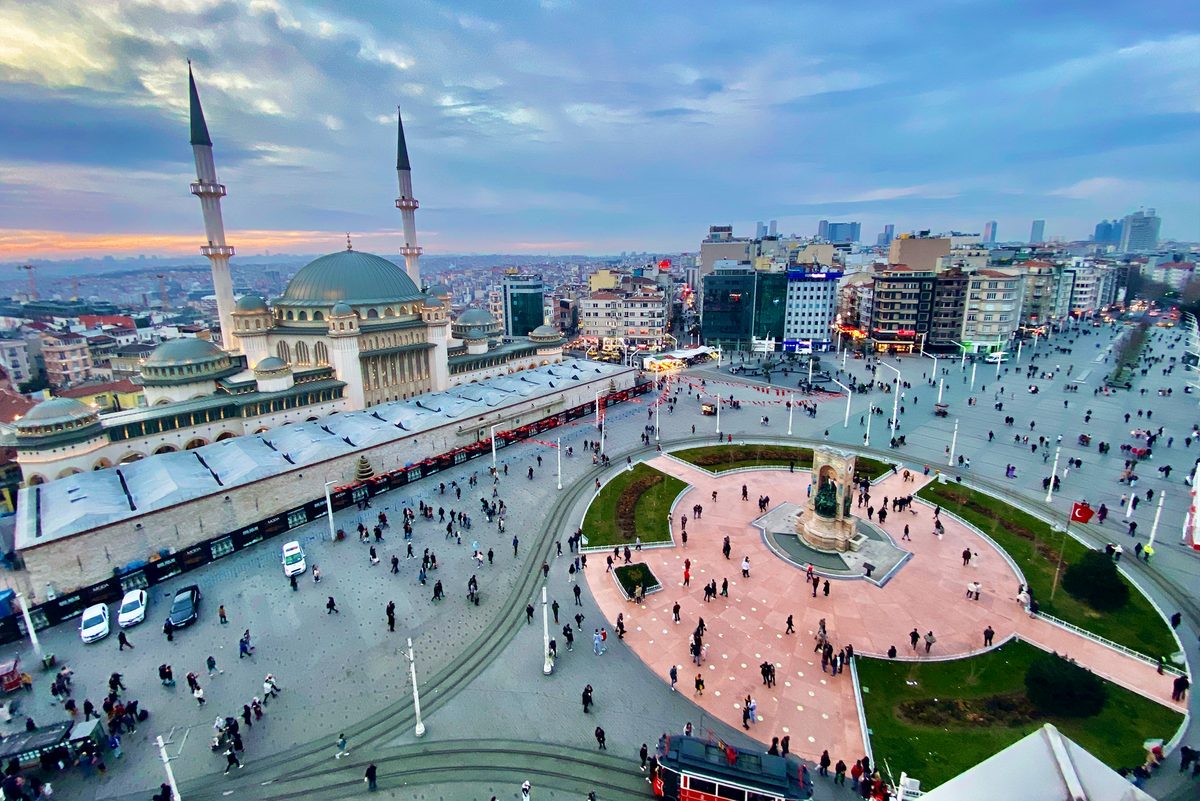
Taksim is where every visitor arrives and almost nobody lingers, which is roughly correct. It is a large paved square that functions as the city’s transport and protest ground rather than a sight. What is on it:
- The Republic Monument (1928), with Atatürk on one side as a soldier and on the other as a statesman, flanked on the second face by Soviet officers who helped in the War of Independence — which is the detail worth walking over for.
- Taksim Mosque, opened in 2021 after decades of argument about whether it should exist. Modern, angular, free to enter outside prayers, and rarely visited by tourists.
- The Atatürk Cultural Centre (AKM), the red-globed opera house rebuilt and reopened in 2021. Worth checking the programme; tickets are absurdly cheap by European standards.
- Gezi Park, the small park behind the monument whose proposed demolition set off the 2013 protests. It is an ordinary park. Its significance is entirely historical.
- The taksim itself — the stone water-distribution chamber of 1732 that gave the square its name, on the corner by the mosque, unmarked and unnoticed by thousands of people a day.
Is Taksim safe at night? Yes, in the ordinary sense — it is busy until very late and heavily policed. The risks are the commercial ones: the friendly stranger who takes you to a bar with a five-figure bill, and pickpockets in the İstiklal crowd. Political demonstrations are occasionally dispersed here with force, and the standing advice from every government is to leave any gathering rather than watch it. The scams and how they run are set out in the Istanbul travel tips guide.
İstiklal Caddesi: walk it downhill, and turn off it constantly
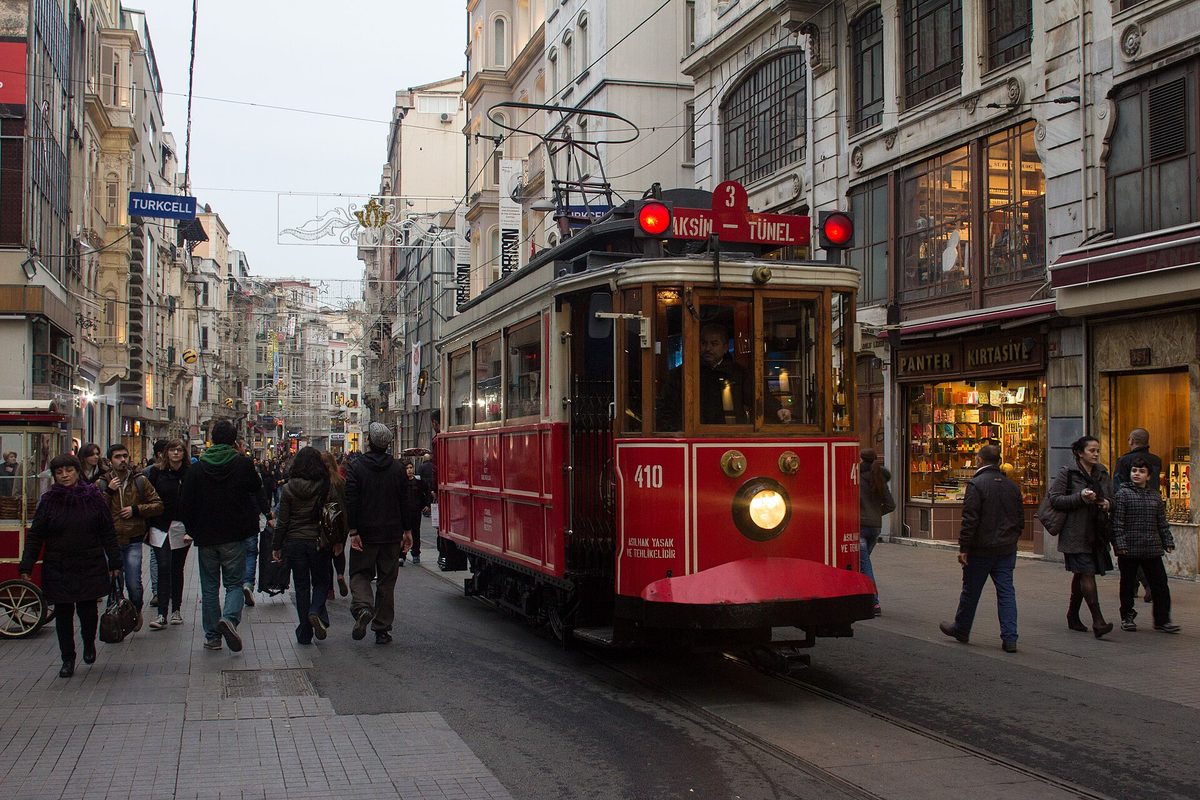
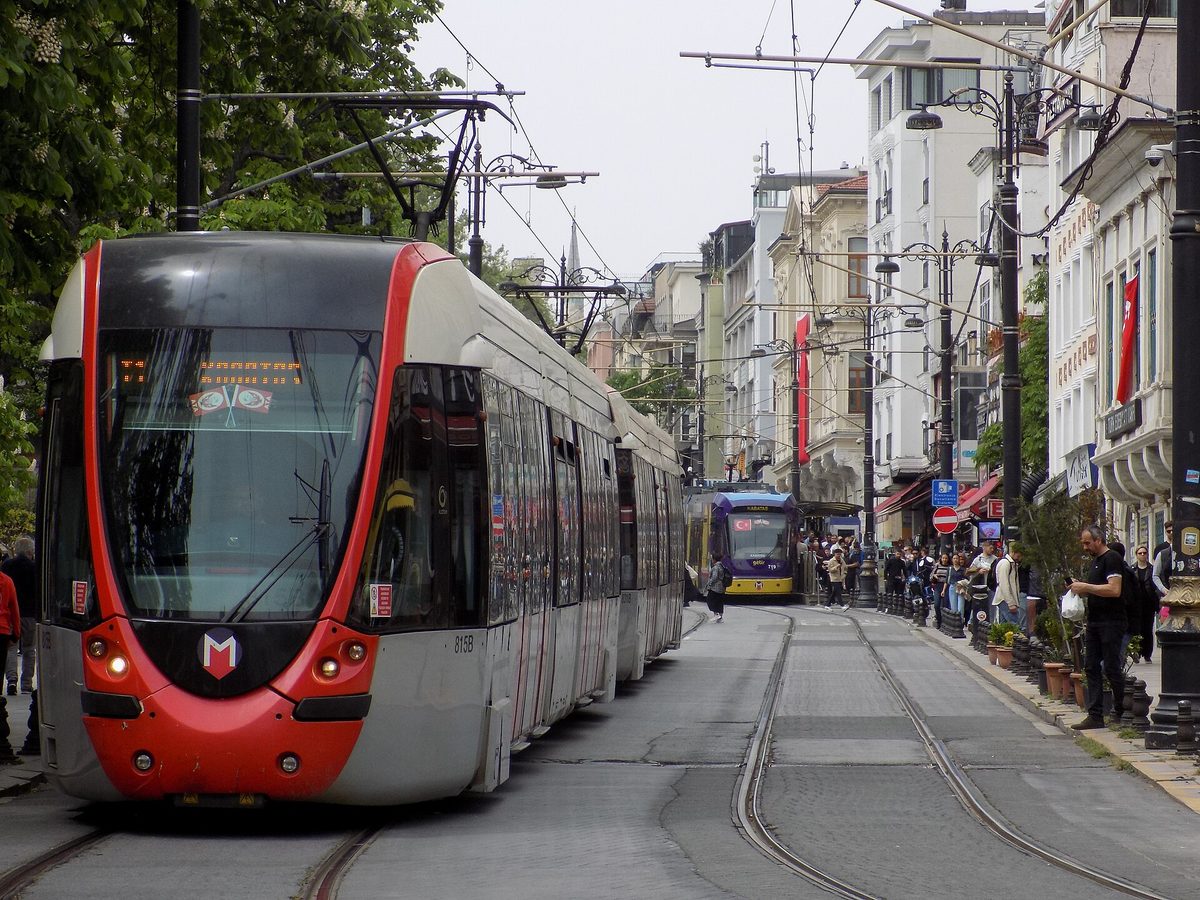
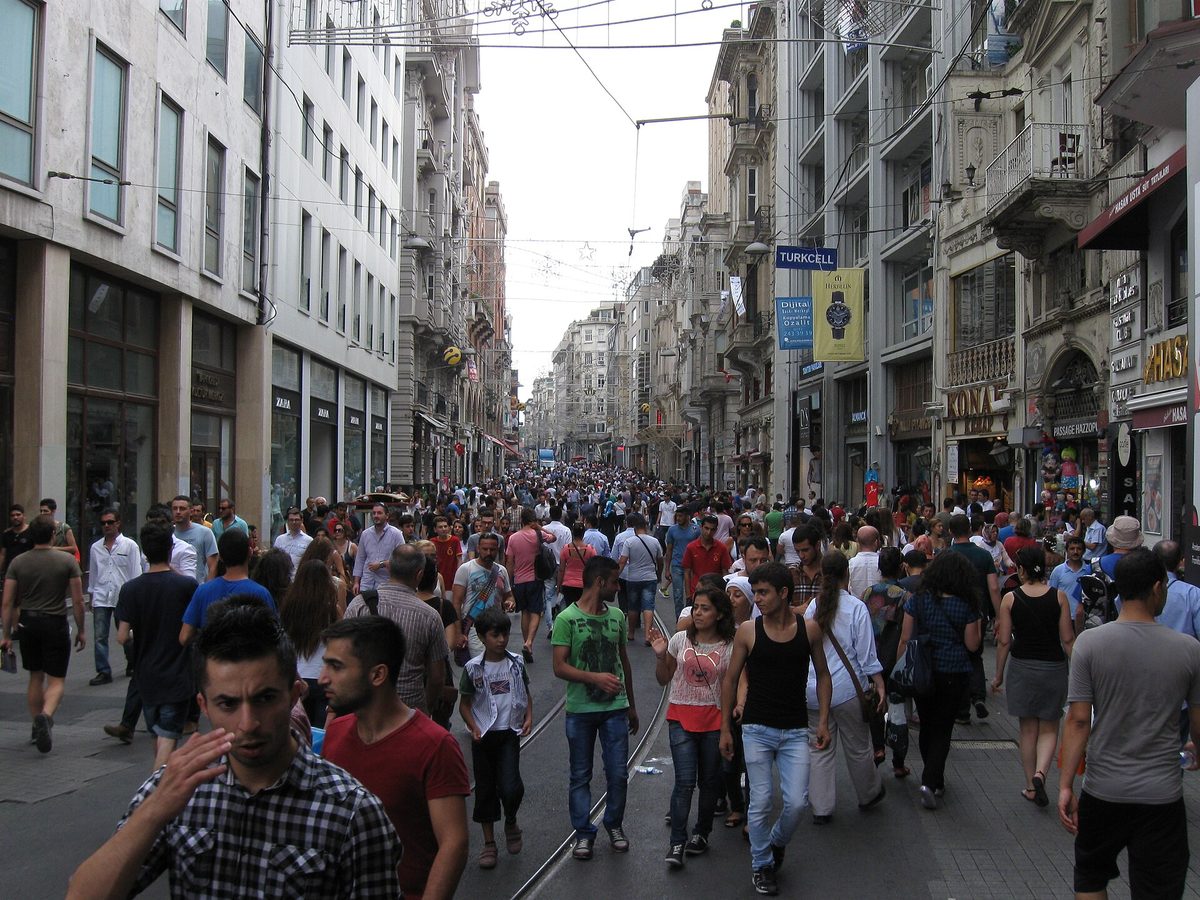
İstiklal — “Independence” — is 1.4 km from Taksim down to Tünel, was the Grande Rue de Péra when this was the European quarter, and carries something like three million people on a good weekend. The nostalgic red tram runs its length on a single track at walking pace, takes an Istanbulkart, and is a novelty rather than transport.
The main street is chain retail. The point of İstiklal is the doors off it.
The passages
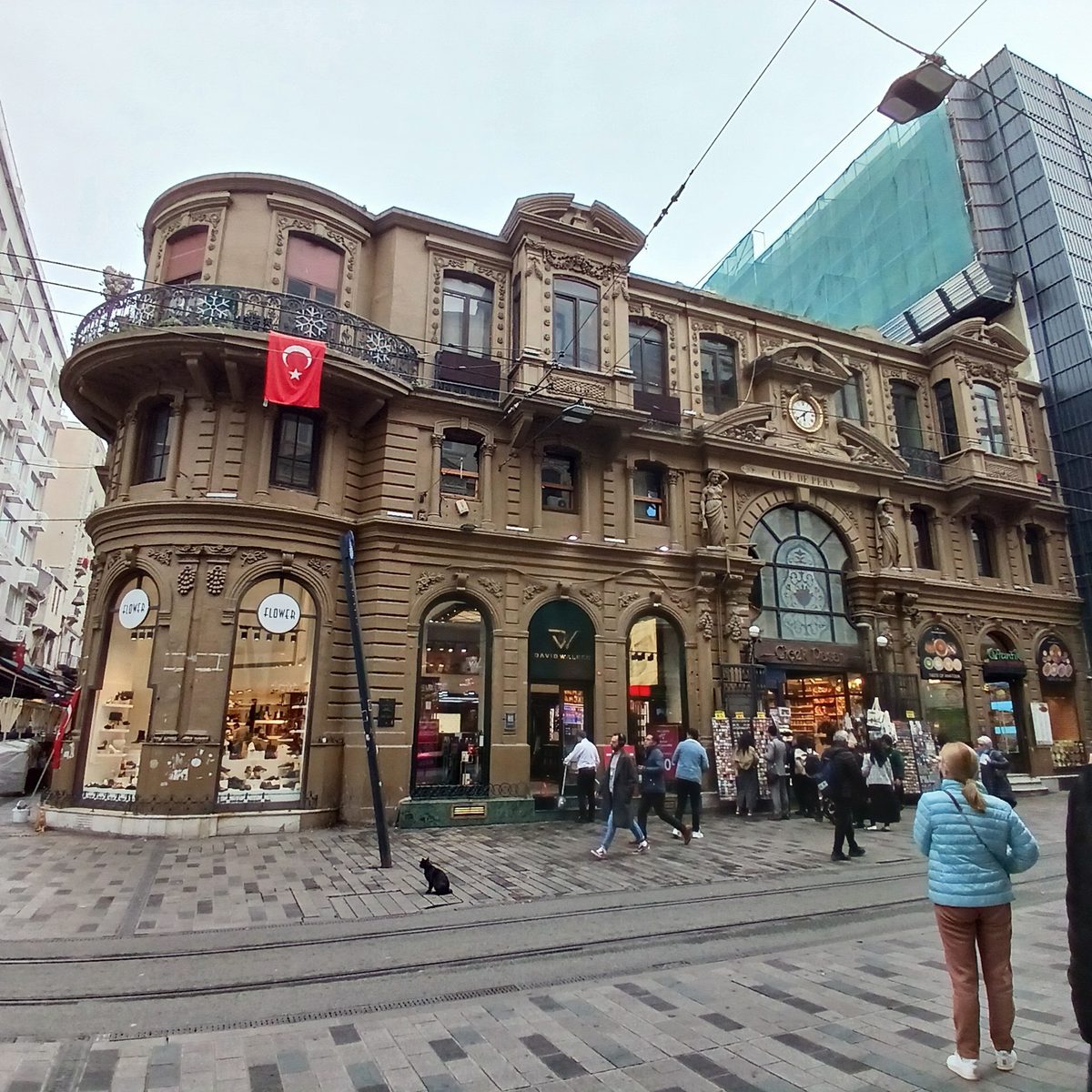
Nineteenth-century arcades cut through the blocks, each one a small covered street. Çiçek Pasajı (1876) is the famous one, gorgeous overhead and a tourist trap at table level — look up, walk through, eat elsewhere. Immediately behind it, Nevizade Sokak is a solid lane of meyhanes where the food is better and the prices are real. Hazzopulo Pasajı is the tea garden one, quiet in the middle of the chaos. Atlas Pasajı has the old cinema and a warren of vintage and vinyl. Halep Pasajı is faded and half-empty and my favourite.
The churches
Beyoğlu was Christian Istanbul and still has the buildings. St Anthony of Padua, the big neo-Gothic Catholic church set back in a courtyard halfway down, is free, open all day and one of the calmest rooms on the avenue. Hagia Triada, the Greek Orthodox church with the twin bell towers, sits just off Taksim Square. The Crimean Memorial Church, Anglican, is tucked down towards Tünel and rarely open. All three are minutes off the main drag and almost empty.
The food stops that are actually worth stopping for
- Mandabatmaz, off İstiklal near Tünel — Turkish coffee, thick enough to stand a spoon in, in a room the size of a cupboard.
- Hafız Mustafa for baklava and lokum. A chain, but a chain since 1864.
- Kızılkayalar on Taksim Square for the ıslak burger, the steamed “wet burger” that sits under glass in tomato-garlic sauce. It costs almost nothing, it is not good food, and it is a genuine Istanbul institution at two in the morning.
- Asmalımescit, the lane network at the Tünel end, for a proper sit-down meyhane dinner. Budget 2,000 TL and up for two with a bottle of rakı and enough meze.
Where the neighbourhood’s food fits into the city’s, and what everything costs, is in the Istanbul food guide.
The museums on and near İstiklal
Pera Museum in Tepebaşı, 300 TL in 2026, holds Osman Hamdi Bey’s The Tortoise Trainer — the single most reproduced painting in Turkey — plus Anatolian weights and Kütahya tiles, in a beautifully converted hotel. The Museum of Innocence in Çukurcuma is Orhan Pamuk’s novel built as an actual museum of objects, and works whether or not you have read the book; the novel contains a ticket for free entry. There is also a small cinema museum and the Jewish Museum of Turkey a short walk down towards Karaköy.
Galata: the tower, the stairs and the streets around them

Galata was the walled Genoese colony across the water from Constantinople, and the medieval street plan survives: narrow lanes on an absurd gradient, running down from Tünel to the water.
Galata Tower — the honest verdict
Built in 1348, 67 metres tall, restored and reopened in 2024, and now the most-reviewed landmark in Istanbul. Entry is €30 for foreign visitors (Turkish citizens pay 650 TL), it is open 08:30 to 23:00 with last entry at 22:00, and admission is capped at around 100 people an hour — which is why the queue outside routinely runs twenty to forty minutes and sometimes much longer.
The view is genuinely one of the best in the city: the whole Golden Horn, the old-city skyline, the Bosphorus opening to the right. Whether it is worth €30 plus half an hour of standing depends on how much you want the specific 360-degree balcony, because you can see roughly the same panorama from the terrace of a dozen bars in Karaköy and Tophane with a drink in your hand for the price of the drink. My rule: go if the tower’s own history interests you, or go at 08:30 when the queue is short. Do not queue at six in the evening for sunset with everyone else.
The rest of Galata
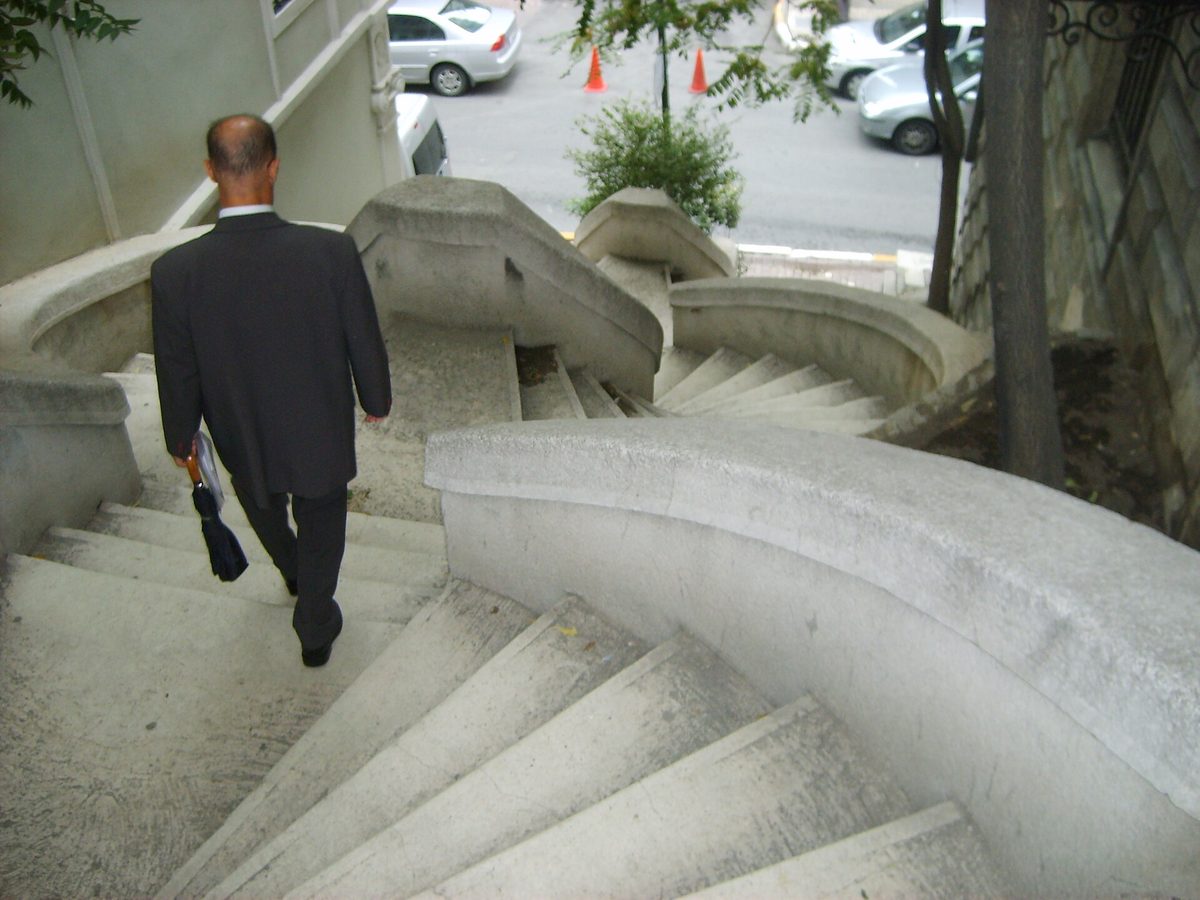
The Kamondo Stairs on Bankalar Caddesi are the district’s other icon: an art-nouveau double helix built by the Camondo banking dynasty, who were the Ottoman Rothschilds and whose story ends at Auschwitz. Bankalar Caddesi itself was the Ottoman Wall Street and is lined with the banking palaces to prove it, including SALT Galata in the old Ottoman Bank — free, with a superb library reading room and a small banking museum in the vaults.
The Galata Mevlevi Lodge, at the Tünel end, is the seventeenth-century dervish hall, €7 to enter and closed Mondays, with a museum of Mevlevi instruments and manuscripts and an octagonal wooden sema floor. Ceremonies are held on some evenings; the schedule shifts, so check before making a plan around it.
Tünel itself, at the top of the hill, is the world’s second-oldest underground urban railway after London’s, opened in 1875, and consists of one very short, very steep climb that saves you the worst hill in Beyoğlu for the price of a standard fare. Take it.
Karaköy and Galataport: coffee, design and a rebuilt waterfront
Karaköy was the port’s working district — chandlers, hardware, wholesale — and over about fifteen years became the part of Istanbul that other cities’ design districts want to be. The hardware shops are still there, on the same streets as the coffee.
- Karaköy Güllüoğlu for baklava, since 1949, and the benchmark by which every other tray in the city is judged.
- Karabatak and the coffee places around Kara Ali Kaptan Sokak — this is where third-wave coffee landed in Istanbul.
- The umbrella street on Hoca Tahsin Sokak, which is a photograph rather than a place, and which everybody takes.
- Kılıç Ali Paşa Hamam, a Sinan building of 1580, restored over seven years and reopened as a working hamam at around 3,400 TL. Women use it 08:00–16:00 and men 16:45–23:30; it is the most beautiful of the tourist-facing hamams and it books out.
- The Yeraltı Camii, the “underground mosque”, in the vaults of a Byzantine fortification below street level near the ferry pier — low, dim, columned, and almost never visited.
Galataport
The 1.2 km of waterfront between Karaköy and Tophane was rebuilt as Galataport and opened in October 2021: around 400,000 m² of development, roughly 250 shops and restaurants, a 980 m quay, and — the engineering trick everyone mentions — a 29,000 m² cruise terminal buried underground with a retractable hatch system, so the promenade stays open to the public except when a ship is actually being processed. It handles up to 15,000 passengers a day and can berth three ships at once; in 2025 it took 595,000 cruise passengers on 224 calls.
As a place to be, it is glossy, expensive and slightly characterless — an international waterfront development that happens to be in Istanbul. Two reasons to go anyway. The promenade itself is the best flat walk in Beyoğlu with the Bosphorus at your elbow. And Istanbul Modern, rebuilt by Renzo Piano and reopened on the site in 2023, is 10,500 m² of Turkish modern and contemporary art with a mirrored roof terrace and a view straight across to Topkapı. Entry ran to 900 TL in 2026. It is the best modern-art museum in the country and worth an afternoon.
Note that entry to the Galataport area involves airport-style security screening. It is quick, it is free, and it surprises people.
Pera, Cihangir and Çukurcuma: the parts people miss
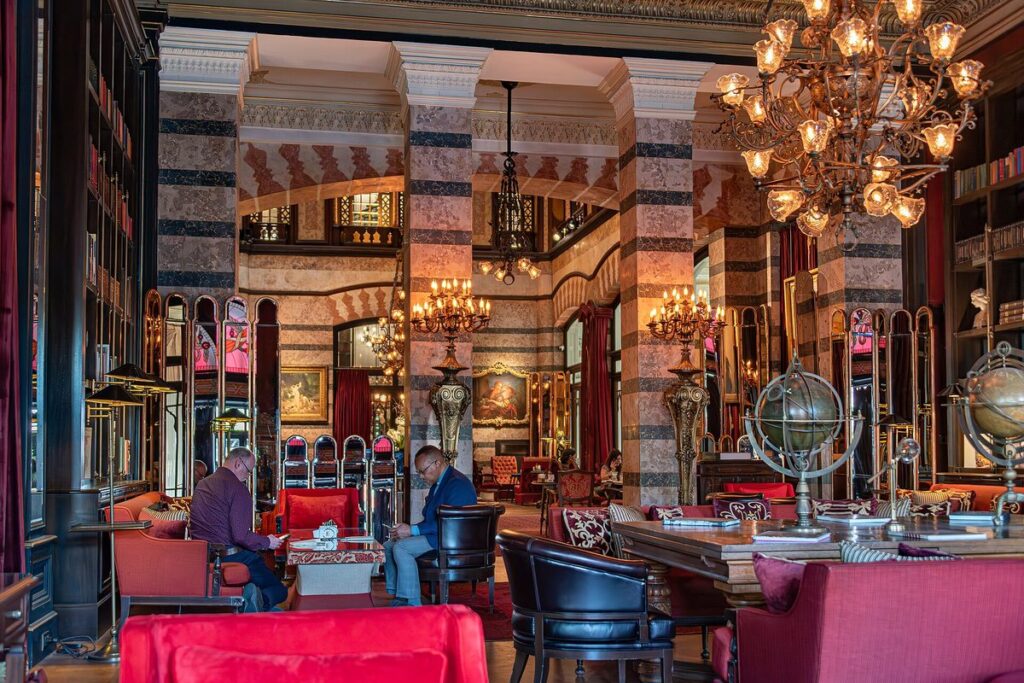
Pera and Tepebaşı are the old embassy and hotel quarter behind İstiklal’s western end. The Pera Palace was built in 1892 to house Orient Express passengers, ran electric lifts and hot running water before anywhere else in the city, and put up Atatürk, Agatha Christie and most of interwar Istanbul’s spies. You do not need a room to sit in the Kubbeli Saloon or the Orient Bar, and a coffee there is one of the better small luxuries in the district. Around it, Tepebaşı and Asmalımescit have the highest concentration of good restaurants in Beyoğlu.
Cihangir is ten minutes downhill from Taksim and a different city: residential, steep, full of plane trees, cats, bookshops, antique dealers and a long-established foreign and creative population. There is nothing to see. That is the point. Have a very long breakfast on Akarsu Yokuşu, walk down to Fındıklı and look at the water. If you are choosing where to sleep, the neighbourhood guide to Istanbul accommodation weighs Cihangir against Karaköy and Sultanahmet properly.
Çukurcuma, between Cihangir and İstiklal, is the antiques quarter — three or four streets of dealers selling everything from Ottoman calligraphy to 1970s Turkish film posters to genuine rubbish. The Museum of Innocence is here. It is the best aimless hour in Beyoğlu, and prices assume you will negotiate.
Tophane, downhill from Çukurcuma towards the water, has Sinan’s Kılıç Ali Paşa Mosque, the Tophane-i Amire cannon foundry now used as a university exhibition hall, and a long tradition of nargile cafés in the square outside the mosque.
How Beyoğlu got like this: a short history that explains the street plan
None of this district makes sense until you know that for most of its existence it was not part of the city at all.
Genoese Galata. In 1273 the Byzantines granted the Genoese a trading colony across the Golden Horn from Constantinople, and they walled it, ran it as a self-governing merchant republic, and in 1348 built the tower as its highest point — the Christea Turris, the Tower of Christ. The steep tangled lanes between Tünel and the water are still that town’s street plan. When Mehmed II took Constantinople in 1453, Galata negotiated a surrender and kept its commercial privileges, which is why it stayed a foreign, Christian, mercantile place inside an Ottoman empire.
Pera and the Grande Rue. By the seventeenth century the European embassies had climbed the hill to the ridge above Galata, into a district the Greeks called Pera — “beyond”. The ridge road linking them became the Grande Rue de Péra, which is today’s İstiklal, and by the nineteenth century it had the first modern apartment blocks in the empire, gas lighting, department stores, the Ottoman Bank on Bankalar Caddesi, and the Pera Palace at the end of it for people arriving on the Orient Express. Beyoğlu was Levantine, Greek, Armenian, Jewish and Italian, and it spoke French.
The twentieth century took it apart. The population exchange with Greece in 1923, the discriminatory wealth tax of 1942, the Istanbul pogrom of September 1955 that gutted Greek businesses on İstiklal in a single night, and the emigration that followed all emptied the district of the communities that built it. By the 1970s the Grande Rue was a dilapidated street of car traffic and cinemas.
Then it came back. İstiklal was pedestrianised in 1990, the nostalgic tram was reinstated on the old rails, and Beyoğlu became first the city’s arts quarter, then its nightlife quarter, then — through Karaköy and Galataport in the 2010s and 2020s — its waterfront again. This is why the district feels layered rather than planned: it is a Genoese town under a French boulevard under an international shopping street, with a cruise terminal buried at the bottom.
It also explains the churches. St Anthony’s, Hagia Triada and the Crimean Memorial Church are not curiosities dropped into a Muslim city; they are what is left of the congregations that lived here. The old city across the water is Byzantine and Ottoman. This side is Genoese and Levantine, and the difference is visible in every doorway.
Nightlife: where to drink in Beyoğlu, and where not to
This is the drinking half of Istanbul — Beyoğlu, Karaköy and Beşiktaş between them hold most of the city’s licensed venues, and the conservative districts across the water hold almost none. Four distinct scenes, and they do not overlap much.
- Meyhanes — Nevizade and Asmalımescit. The proper Turkish night out: a long table, cold meze brought on a tray, hot meze after, fish at the end, rakı throughout, and live fasıl music in some places. It runs three hours minimum and 2,000 TL and up for two. This is the one to do.
- Rooftop bars — Karaköy and Tophane. The view without the Galata Tower queue. Expect 300–500 TL for a cocktail at the smarter ones and a reservation requirement at weekends. The best of them look straight across the Golden Horn at the old-city skyline.
- Small bars — Cihangir and the Tünel end. Where residents drink. Cheaper, unpretentious, often with music, and considerably more pleasant than anything on İstiklal itself.
- Clubs — Karaköy, and the Bosphorus shore beyond. The famous ones are up at Ortaköy and Kuruçeşme rather than in Beyoğlu proper, and they operate a door policy and a table-minimum system that means a night out costs what a weekend costs elsewhere.
Where not to drink: any bar you are led to by a friendly stranger you met on the street, particularly if you are a man travelling alone. The inflated-bill scam is a Beyoğlu speciality and runs to five figures. Pick the bar yourself, or do not go.
Two practical notes. Retail alcohol sales are banned nationwide between 22:00 and 06:00, so buy from a shop before ten if you want a bottle for the hotel; licensed bars and restaurants are unaffected and run late. And alcohol is heavily taxed — a beer is 200–350 TL in a bar and a bottle of rakı starts around 900 TL in a shop, which is why so much drinking happens at a meyhane table where the rakı is the point rather than an accessory.
Shopping: what is actually worth buying here
İstiklal’s main frontage is the same global brands you have at home. The things worth carrying home from Beyoğlu are elsewhere in the district.
| What | Where | Rough price |
|---|---|---|
| Antiques, prints, film posters | Çukurcuma | Negotiable, and expected to be |
| Vinyl, vintage clothes, cameras | Atlas Pasajı and around | 500–4,000 TL |
| Contemporary Turkish design and ceramics | Karaköy, around Kara Ali Kaptan Sokak | Fixed prices, not cheap |
| Baklava to take home | Karaköy Güllüoğlu | 800–1,600 TL a kilo |
| Turkish coffee, freshly ground | Mandabatmaz and the shops near Tünel | 200–400 TL |
| Books in English, secondhand | Cihangir and the Tünel end | 150–600 TL |
| Musical instruments | Galip Dede Caddesi, Tünel to Galata | Wide, and worth browsing regardless |
Galip Dede Caddesi is the one to walk even if you buy nothing: a steep street from Tünel down to the tower lined with shops selling saz, ud, ney, darbuka and every kind of guitar, with people trying them out in the doorways. Haggling is normal in Çukurcuma and on the antique stalls, and not normal in the design shops, the patisseries or anywhere with a printed tag — the rules are the same as the ones in the general things-to-do guide.
Getting around Beyoğlu
| Route | How | Time | Fare |
|---|---|---|---|
| Sultanahmet to Beyoğlu | T1 tram to Karaköy, then Tünel funicular | 25 min | Standard fare plus transfer |
| Kabataş to Taksim | F1 funicular | 3 min | Standard fare |
| Karaköy to Tünel / İstiklal’s foot | Tünel funicular | 90 seconds | Standard fare |
| Taksim to Galata Tower | Walk down İstiklal | 25–30 min | Free, and downhill |
| Kadıköy to Karaköy | Ferry | 20 min | 57.00 TL |
| Istanbul Airport to Taksim | Havaist HVL-9 coach | 60–90 min | 470 TL |
The single most useful piece of local knowledge: walk down, ride up. Taksim is at roughly 60 m and Karaköy is at sea level, and the streets between them are stepped in places. Start at the top, end at the water, and take the funicular or the tram home. The lines, cards and transfer rules are in the Istanbul transport guide.
A day in Beyoğlu, downhill
- Breakfast in Cihangir. Long, slow, lots of small plates.
- Walk up through Çukurcuma to İstiklal, stopping in the antique shops.
- Down İstiklal, turning off at St Anthony’s, Hazzopulo and Atlas Pasajı. Coffee at Mandabatmaz.
- Lunch in Asmalımescit or Nevizade.
- Galata: the Mevlevi Lodge, the tower from outside, the Kamondo Stairs down Bankalar Caddesi, SALT Galata’s reading room.
- Karaköy: baklava at Güllüoğlu, the design shops, the umbrella street.
- Istanbul Modern at Galataport, then the promenade as the light goes.
- A rooftop bar in Karaköy for the view you did not queue for.
- Meyhane dinner back up in Nevizade. Rakı, meze, three hours.
That is a full and fairly hard day of walking, all of it downhill except the last climb. Add a hamam at Kılıç Ali Paşa in the afternoon slot if you want to lose two hours very well. How this fits with the rest of the city is set out in the Istanbul itineraries.

Where to base yourself within Beyoğlu
“A hotel in Taksim” covers about two square kilometres and four very different experiences, and the listing sites are no help at all because every property within a twenty-minute walk of the square calls itself Taksim. The differences that matter are noise, gradient and how far you are from a metro.
Karaköy — my default
At the bottom of the hill, on the water, with the T1 tram, the ferry pier and the Tünel funicular all within five minutes. You are twelve minutes from Sultanahmet by tram and ten minutes uphill from Galata. Nights are quiet in the residential streets and lively on the waterfront. The catch is that Karaköy has gone from cheap to expensive in about a decade, and there is very little budget stock.
Galata — the postcard option
Small hotels in restored buildings around the tower, cobbled lanes, and a genuine sense of place. The catch is the gradient: everything here is on a slope steep enough that a wheeled suitcase is a real problem, and the streets immediately around the tower carry crowds until late.
Cihangir — for a longer stay
Residential, leafy, ten minutes’ walk downhill from Taksim, with the best breakfast culture in the district and almost no tourists sleeping in it. The catch is that there is no metro station and the walk back up from Fındıklı at the end of a day is punishing.
Taksim and İstiklal — convenient, and I would not
The M2 metro, the F1 funicular and the Havaist airport coach all stop here, which is genuinely valuable if you are arriving late or leaving early. Against that: the blocks immediately off İstiklal are loud until three in the morning, the hotels are mostly large and characterless, and you walk downhill to everything and back up at the end of the night. Book here for a one-night stopover, not for a week.
Asmalımescit and Tepebaşı — for eating
The restaurant end of İstiklal, near Tünel, the Pera Museum and the Pera Palace. Good boutique stock at fair prices, an easy walk down to Galata, and noise that depends entirely on which side of the building your room faces. Ask.
Across the whole district, three things to check before you book: whether the building has a lift (many nineteenth-century conversions do not, and the rooms are on the fourth floor); how far the nearest tram, metro or funicular actually is on foot rather than in a straight line on the map; and which way the windows face if you are near a bar street. The full comparison against Sultanahmet, Beşiktaş and the Asian side is in the Istanbul accommodation guide, and rough rates run from about €10–15 for a hostel dorm to €55–100 for a decent private room in this district.
What is overrated in Beyoğlu
- Çiçek Pasajı’s restaurants. A beautiful room with a captive audience and prices to match. Walk through it, then eat in Nevizade forty seconds away.
- The Galata Tower queue at sunset. €30 and an hour of your evening for a view you can buy with a beer in Karaköy. Go at opening time or not at all.
- İstiklal itself, if you only walk the middle. The chain-store spine is the least interesting thing in the district. Everything good is off it.
- The nostalgic tram as transport. It is slower than walking, it is always full, and you will spend more time waiting for it than riding it. Ride it once for the photograph.
- Taksim as a base. People book hotels here because the metro and the airport coach are convenient. You will then walk fifteen minutes downhill to everything you actually want and fifteen minutes back up. Karaköy, Galata or Cihangir are better.
- Any bar you are taken to by somebody you met on İstiklal. This is the district where that scam lives.
Frequently asked questions about Beyoğlu
Is Beyoğlu worth visiting, or should I stay in the old city?
Both, and they do different jobs. The old city is where the monuments are — Hagia Sophia, Topkapı, the bazaars, the great mosques — and you will spend two days there. Beyoğlu is where the food, the drinking, the coffee, the modern art and the actual daily life of the city are, and if you skip it you will have seen Istanbul as a museum rather than a place. On a three-day trip, give the old city a day and a half and Beyoğlu a full day plus both evenings.
What is the best time of day to be in Beyoğlu?
Late afternoon into the evening. The district is genuinely dull at nine in the morning — the shops are shut, the passages are closed and İstiklal is being hosed down. Things open properly around eleven, the light on the Galataport promenade is good from about five, and the meyhanes fill from eight. If you are an early riser, do the old city in the morning and cross the bridge after lunch.
Is Beyoğlu a good area to stay in Istanbul?
Yes, and better than Sultanahmet for anything longer than two nights, because it is where the restaurants, bars and daily life are. Within it, Karaköy, Galata and Cihangir are the pleasant choices; Taksim is the convenient but soulless one; the streets immediately around İstiklal are noisy until three in the morning.
How do I get from Sultanahmet to Beyoğlu?
T1 tram to Karaköy, then either walk across and up, or take the Tünel funicular to the foot of İstiklal. About 25 minutes door to door for a standard fare plus a transfer. Walking across Galata Bridge instead of transferring is slower and much better.
Is İstiklal Street worth visiting?
The passages, churches and side lanes are; the main avenue is a chain-store shopping street with a heavy crowd. Treat İstiklal as a spine to keep leaving rather than a destination in itself, and it becomes one of the best walks in the city.
Is Galata Tower worth €30?
For a first visit and if you go at 08:30 when the queue is short, yes — it is the best 360-degree view in the city. At six in the evening, with a forty-minute queue and a 100-person-per-hour cap, no. A rooftop bar in Karaköy gives you most of the same panorama for the price of a drink.
Is Taksim safe at night?
Yes in the ordinary sense — busy, lit and policed until very late. The real risks are commercial rather than violent: the inflated bar bill run by a friendly English-speaking stranger, and pickpockets in the İstiklal crowd. Avoid political gatherings, which are occasionally dispersed forcefully.
What is the difference between Beyoğlu, Taksim and Galata?
Beyoğlu is the whole district. Taksim is the square and transport hub at its top end. Galata is the medieval quarter around the tower at the bottom. İstiklal is the avenue joining them. People use the names loosely and hotels use “Taksim” for anything within a twenty-minute walk of the square.
How long do you need in Beyoğlu?
A full day covers İstiklal, Galata, Karaköy and Galataport at a decent pace. Two days lets you add Cihangir, Çukurcuma, Pera and a hamam without rushing, which is how the district is best used.
Can you walk from Taksim to Galata Tower?
Yes — straight down İstiklal to Tünel and then a few minutes into the Galata lanes, 25 to 30 minutes and downhill the whole way. Doing it in reverse is a genuine climb; take the Tünel funicular up instead.
What is there to do in Karaköy?
Coffee, baklava at Güllüoğlu, design and concept shops, the Kılıç Ali Paşa hamam, the underground mosque, the Galataport promenade and Istanbul Modern, and the rooftop bars with the old-city view. It is a half day that becomes a whole one easily.
Is Galataport free to enter?
Yes. The promenade and the shopping area are public and free, though you pass through airport-style security screening to get in. Istanbul Modern inside it is ticketed separately, at around 900 TL in 2026.
Kılıç Ali Paşa is the bath most people end up recommending, and its timetable — women until four, men from a quarter to five — catches couples out. Our guide to Turkish baths in Istanbul compares every hamam worth booking with September 2026 prices, and explains exactly what happens once you are inside.
Four of Istanbul’s Michelin-starred restaurants are in or near this district, alongside the best meyhanes in the city and a grill at the foot of İstiklal that locals queue for. Our guide to Istanbul’s best restaurants, by style and neighbourhood covers where to book and where to walk in.
Once the sun goes down, the meyhanes on Nevizade and the rooftop bars a few streets over are where this neighbourhood earns its reputation. Our Istanbul nightlife guide covers meyhane etiquette, the honest rooftop-bar list, and 2026 drink prices by area.
Beyond İstiklal’s cafes and bars, this district holds three of the best small museums in the city — Pera, SALT Galata and the Museum of Innocence in Çukurcuma. Our best museums in Istanbul guide covers all three, with current prices and closed days.
Related Istanbul guides
- Things to do in Istanbul — forty of them, across every district.
- Where to stay in Istanbul — Karaköy and Cihangir against the alternatives.
- Sultanahmet and the old city — the other half of the walk across the bridge.
- Getting around Istanbul — the funiculars that save you the hills.
- Istanbul travel tips — the İstiklal scams and how they work.
- What to eat in Istanbul — meyhane dinners, ıslak burger and baklava.
- Bosphorus cruises — boats leave from Karaköy and Kabataş.
- Istanbul itineraries — where a Beyoğlu day fits.
- Day trips from Istanbul — when the city is finished with you.
- The best time to visit Istanbul — rooftop season and rain season.