The queue I joined at the upper-gallery entrance in April contained four people who had bought their tickets from a website that was not the official one, two who thought their Museum Pass covered it, and one man who had arrived at 12:15 on a Friday and was about to be told to come back at half past two. Only one of those three mistakes is expensive. All three are avoidable in about ninety seconds of reading.
Visiting Hagia Sophia costs foreign visitors €25 for the upper-gallery route, open 09:00–19:30 and from 08:00 between April and September, with tourists cleared on Fridays from about 12:00 to 14:30. The Blue Mosque, four minutes away, is free and always has been. Both close to visitors around each of the five daily prayers.
This guide covers both buildings together, because almost nobody visits one without the other and the two timetables interlock in ways that decide your morning. Prices and hours were checked on 10 September 2026. I have also been blunt about the restoration, which is the single biggest thing affecting whether the ticket is worth buying right now, and which the ticket-selling sites near the top of the search results are notably quiet about.

Hagia Sophia and the Blue Mosque at a glance
Everything in this table was checked on 10 September 2026, converting at €1 ≈ 56 TL, $1 ≈ 48 TL and £1 ≈ 65 TL. The euro prices are the ministry’s own and barely move; lira prices in Istanbul drift upward through the year, which is why the state has quoted foreign-visitor tickets in euros since 2024.
| Hagia Sophia | Hagia Sophia History & Experience Museum | Blue Mosque | |
|---|---|---|---|
| Adult ticket | €25 (under 8 free) | €25 | Free, always |
| Turkish citizens | Free, main floor, as worshippers | Reduced | Free |
| Opening hours | 09:00–19:30; 08:00–19:30 Apr–Sep | 09:00–22:00, last entry 21:00 | Visitor windows between prayers |
| Friday | Tourists out ~12:00–14:30 | Normal | Visitors from ~14:30 only |
| Prayer closures | Shuts ~15 min before each of five daily prayers | None | Closed ~90 min around each prayer |
| Museum Pass | Not accepted | Not accepted | n/a |
| Route | Upper galleries only for foreign visitors | 13 rooms, multimedia | Rear section of the prayer hall |
| Time needed | 60–75 min | 60 min | 20–30 min |
| Dress code | Shoulders, knees; hair covered for women | None | Shoulders, knees; hair covered for women |
| Shoes | Off, bag provided | On | Off, bag provided |
| Photography | Allowed, no flash | Allowed | Allowed, not during prayer |
| Restoration | Dome and facades under multi-year works | Complete | Complete since 2023 |
Hagia Sophia: what the €25 actually buys you now
The rules changed in January 2024 and a great deal of the advice online still describes the building as it was before. Here is the current arrangement, plainly.
Since the reconversion to a mosque in July 2020, Hagia Sophia has functioned as a working mosque with free entry for worshippers. Foreign visitors were admitted free to the main floor until the start of 2024, when the ministry introduced a €25 ticket and separated the two flows: worshippers use the main prayer floor at ground level, tourists use a dedicated entrance on the north side and a route through the upper galleries. Under-eights go free. The ticket is not covered by the Museum Pass, the E-Pass, or any of the city cards, whatever their marketing implies.
The restoration, and whether it changes the answer
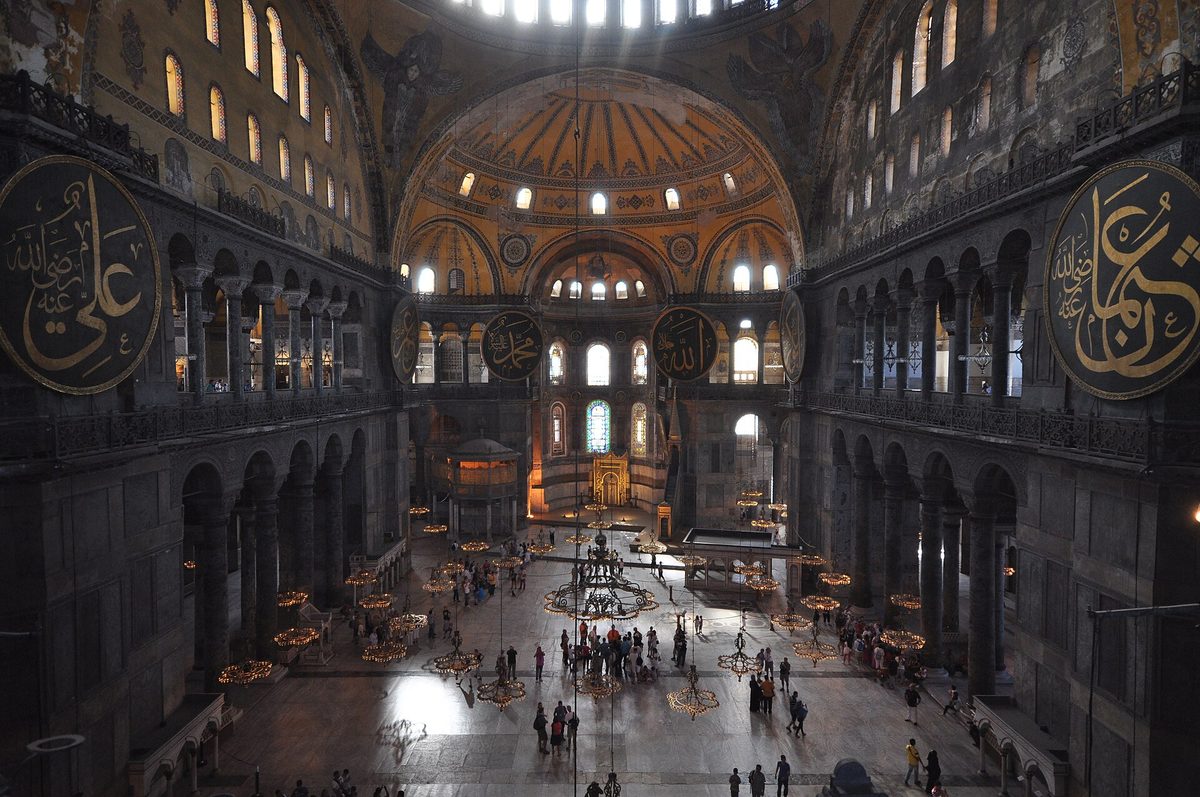
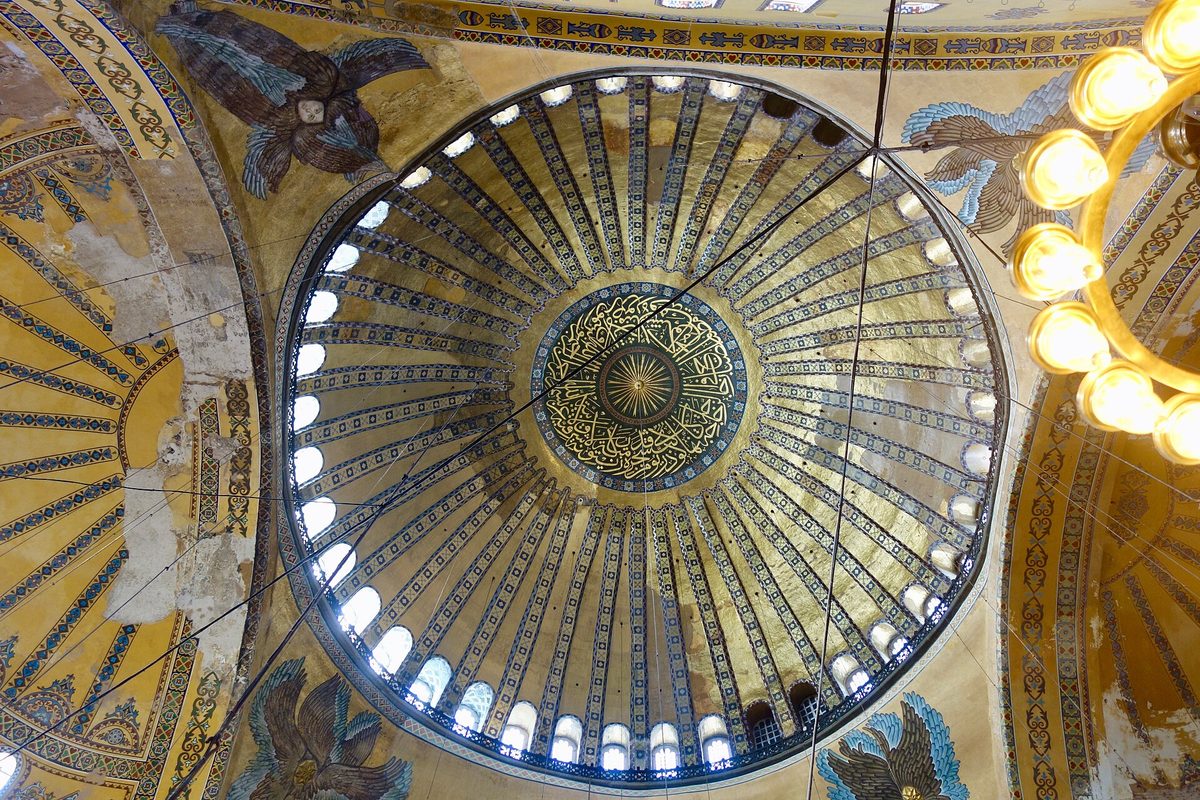
The dome and the exterior facades are in the middle of a multi-year restoration programme. There is roughly 11,000 square metres of scaffolding involved, a protective cover has been over the dome since 2025, four large internal support columns stand in the nave, and the apse mosaic of the Virgin and Child has spent long stretches curtained off. Photographs on the ticket-reselling sites almost universally show the building as it looked before all of this.
So, honestly: if this is your first visit, go anyway. What survives the scaffolding is still the interior volume, the marble revetment, the Byzantine capitals and the gallery mosaics, and none of it looks like anything else. If you stood on the main floor before 2020 and remember walking in under the dome, I would think much harder. The gallery route is a different building emotionally — you look down into the space rather than standing in it — and €25 spent at Topkapı or on the Archaeology Museums and the Turkish and Islamic Arts Museum together buys more.
What you will actually see on the gallery route
You climb a stone ramp — not stairs, a spiral ramp built for horses and litters — to the south gallery, and the route runs round the upper level.
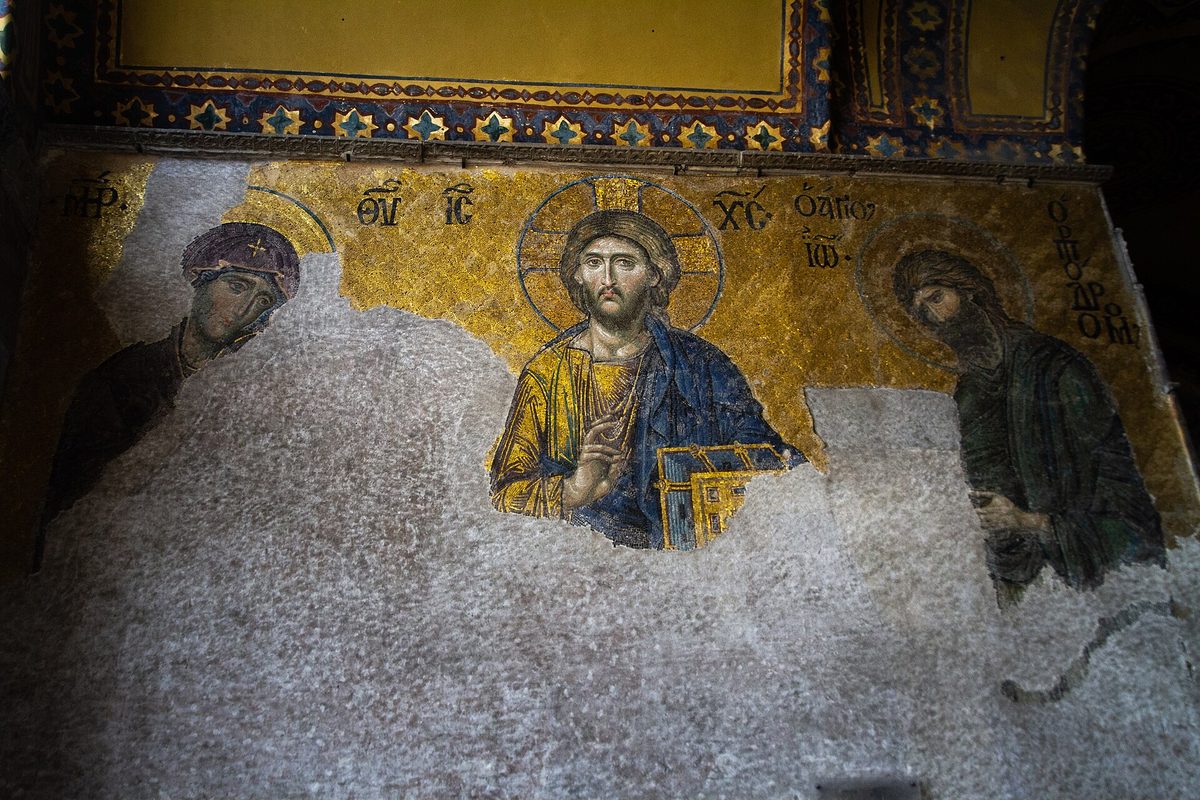
The Deesis mosaic, from around 1261, is the reason to be up there. Christ between the Virgin and John the Baptist, in what survives of a much larger panel, with modelling of the faces that is closer to the Renaissance than to anything else from thirteenth-century Byzantium. Roughly two-thirds of it has fallen away, which somehow makes the surviving heads more affecting rather than less. You can stand a couple of metres from it. On the main floor you never could.
The Empress Zoe panel, also in the south gallery: Christ enthroned between Constantine IX and Zoe, with the emperor’s head visibly recut. Zoe outlived three husbands and the mosaic was updated each time, which is the best gossip available in a religious building.
The Comnenus mosaic beside it, from 1122, is the more beautiful of the two — John II, Irene and their son, with Irene’s Hungarian colouring rendered honestly rather than flatteringly.
The marble door, a heavy Byzantine partition in the south gallery, worn smooth by fifteen hundred years of hands.
The Viking graffiti. On the parapet of the south gallery, a Norse guardsman scratched runes that are usually read as “Halfdan carved these runes”. It is faint, it is unlabelled in any obvious way, and staff will point at it if you ask. It is my favourite thing in the building.
What you do not get on the gallery route: the main floor, the mihrab, the sultan’s lodge up close, and the so-called weeping column with the worn thumb hole, which is a ground-floor fixture. Nobody tells you this at the ticket desk.
You can, however, see a good deal of the ground floor from above, and in some ways the view is better. The omphalion — the disc of coloured marble where Byzantine emperors were crowned — reads as a pattern from the gallery and as a scuffed floor from ground level. The scale of the eight enormous calligraphic roundels, added in the nineteenth century and each about seven and a half metres across, only registers when you are level with them. And the ramp itself is worth slowing down for: a stone spiral wide and gentle enough for animals to climb, worn into troughs by fifteen centuries of feet, with nothing modern in it at all.
The parts of the complex that cost nothing
The ticket covers the building. It does not cover, and does not need to cover, several things in the grounds that most visitors walk straight past.
The sultans’ tombs, along the south side of the building, are free. Selim II’s tomb is a Sinan design of the 1570s and, in tile and proportion, better than anything you will see inside the Blue Mosque; Murad III and Mehmed III are next to it, and the Byzantine baptistery beside them was converted into a tomb for Mustafa I and İbrahim. There is also a tomb of the princes, holding a distressing number of very small sarcophagi — the consequence of a succession law that had brothers killed on a sultan’s accession. Hours roughly track the mosque’s and the doors are sometimes shut without warning; look for the gate on the Kabasakal Caddesi side.
The excavated fragments in the forecourt are the remains of the church that stood here before Justinian’s, burnt down in the Nika riots of 532. The carved frieze of twelve lambs, lying at ground level a few metres from the entrance queue, is fifth-century, older than everything above it, and I have never seen anybody photograph it.
The ablution fountain in the garden, an octagonal Ottoman şadırvan from 1740, is one of the most beautiful small buildings on the peninsula and functions mainly as somewhere for tour groups to stand.
Hürrem Sultan Hamam, the long low building between the two monuments, is a working Sinan bathhouse from 1556 rather than a monument, and prices start around €110 — mentioned here mostly so you know what it is, since a surprising number of people mistake it for a museum and walk in.
Hours, prayer closures and the Friday problem
Hagia Sophia opens at 09:00, and at 08:00 from April to September, closing at 19:30. It shuts to visitors about fifteen minutes before each of the five daily prayers and reopens shortly after, so a badly timed arrival costs you twenty minutes rather than the afternoon.
Friday is different. Tourists are cleared from roughly 12:00 until about 14:30 for congregational prayer. Since the Blue Mosque does the same thing on a slightly wider schedule, Friday morning is the single worst half-day of the week to plan around these two buildings, and Friday afternoon from three o’clock is one of the best — the coaches have moved on and both interiors are calmer.
Prayer times move with the sun, by roughly two hours between midsummer and midwinter. Any fixed table you find, including the ones in this guide, is an approximation. Check the Diyanet’s own prayer-time page for Istanbul on your date, and treat the published times as the moment the doors close rather than the moment you should be arriving.
Tickets: where to buy and what to ignore
The official channel is ayasofyacamii.gov.tr, and the ministry’s museum system at muze.gov.tr. That is it. A large majority of the results for “Hagia Sophia tickets” are resellers, tour operators and lookalike domains selling a €25 ticket for €35–60, sometimes bundled with a guide you did not want. Some of them are perfectly legitimate tour businesses; none of them can get you in faster than the official site can.
In July and August, buying online the night before saves a real queue, sometimes forty minutes. In January and February you can walk up. There is no legitimate “skip the line” product beyond the ordinary timed ticket.
The History and Experience Museum
Under the forecourt, a thirteen-room multimedia exhibition on the building’s fifteen centuries, €25, open 09:00 to 22:00 with last entry at 21:00, about an hour. It is well made. It is also, in a city where €25 buys you the Archaeology Museums and the Turkish and Islamic Arts Museum together with change, an odd thing to buy on a short trip. Its real use is as an evening activity, since almost nothing else in Sultanahmet is open at nine at night.
Fifteen centuries, briefly, because it changes what you look at
Justinian’s church was built between 532 and 537 by Anthemius of Tralles and Isidore of Miletus — a mathematician and a physicist rather than architects, which shows in the ambition and in the fact that the first dome came down in an earthquake in 558. The replacement, steeper and stronger, is what stands. For nearly a thousand years it was the largest enclosed space anyone had built, and the technique that made it possible — a dome carried on pendentives over a square plan — is the single most consequential idea in the history of the region’s architecture. Every mosque you will see in Istanbul is descended from this room, including the one across the park.
It was the cathedral of Constantinople until 1204, when the Fourth Crusade sacked the city and stripped it; the horses now on the front of St Mark’s in Venice came from the Hippodrome next door in that raid. Latin rule lasted until 1261, which is when the Deesis mosaic was made, as a statement of restoration. In 1453 Mehmed II took the city and converted the church to a mosque; the minarets went up over the following century, the figural mosaics were plastered rather than destroyed, and that plaster is the reason they survive. Atatürk’s government secularised it in 1934 and it opened as a museum in 1935. In July 2020 a court annulled that decision and it became a mosque again.
The mixture in the room follows from all of that: Byzantine mosaics and Ottoman calligraphic roundels in the same sightline, a mihrab set slightly off the building’s axis because Mecca is not where Justinian’s apse points, and marble hauled from Egypt, Thessaly and the Aegean by an emperor who was explicitly trying to outdo Solomon.
The Blue Mosque: free, and there has never been a ticket

Sultanahmet Camii, built for Ahmed I between 1609 and 1616 by Sedefkâr Mehmed Ağa, a pupil of Sinan. It costs nothing. It has never cost anything. Every site selling a Blue Mosque ticket is selling a guided tour, a bundle, or a fiction, and this is the most common piece of misinformation in Istanbul travel search.
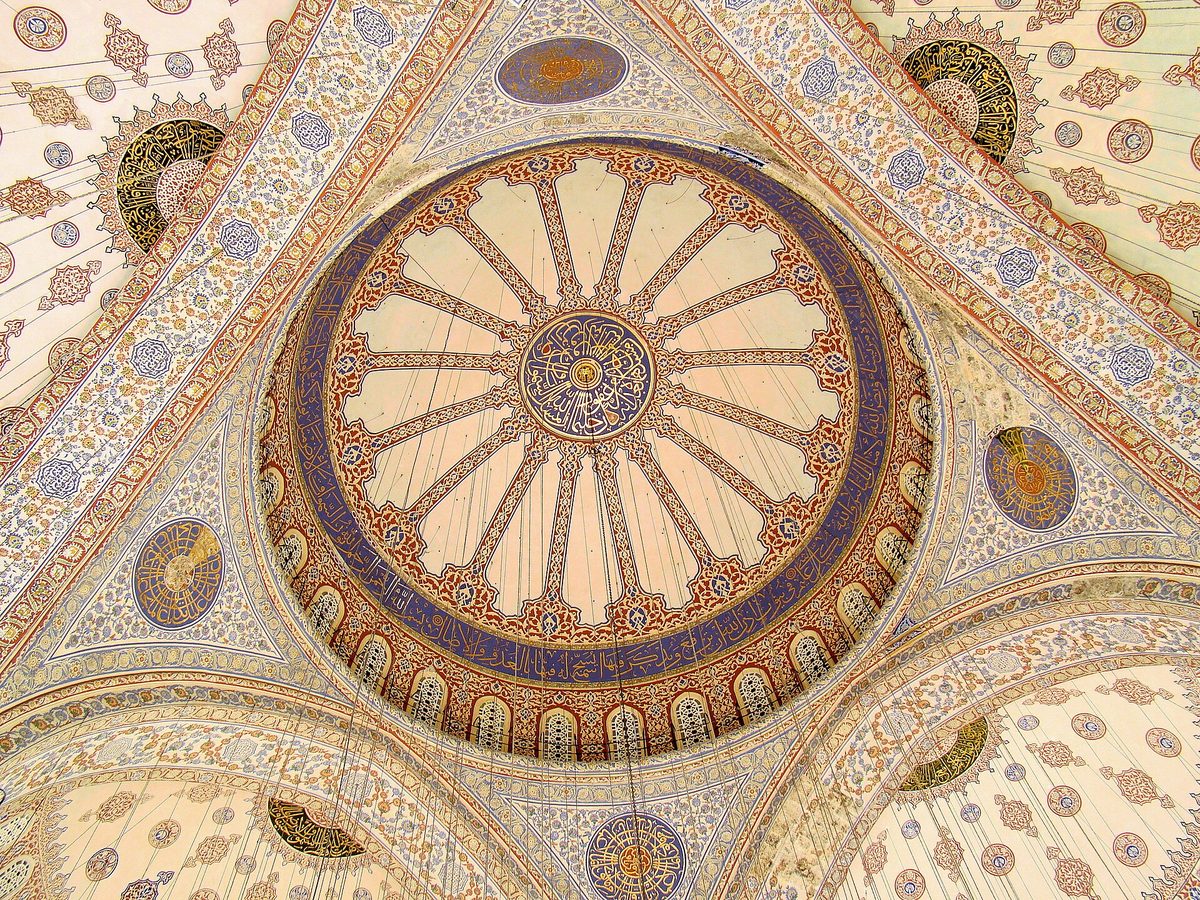
The 2018–2023 restoration is finished and the scaffolding is gone, which matters because a lot of otherwise decent guides were written during the years when the interior was a forest of poles. What you get now is the complete room: six minarets outside, a cascade of half-domes, more than twenty thousand İznik tiles, and around 260 windows that were once filled with Venetian glass.
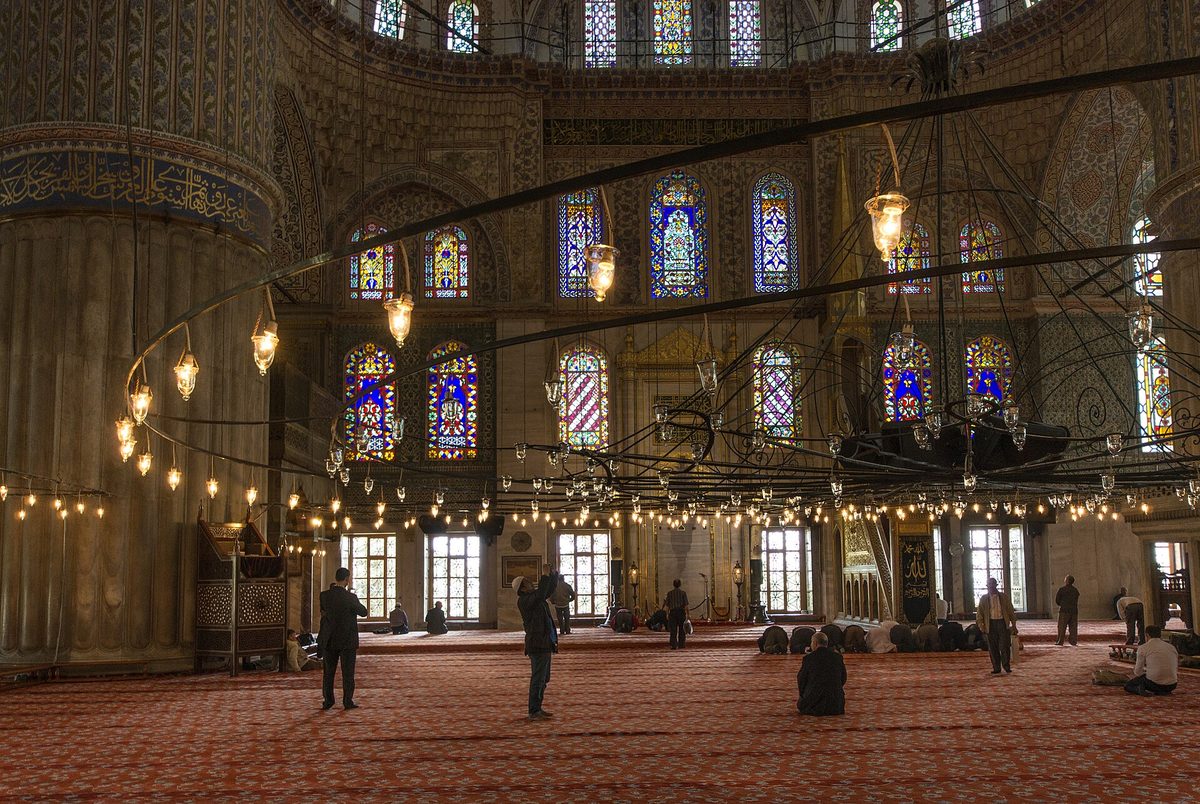
A caveat I will give you that the mosque will not: most of the famous blue tiles are in the galleries, well above head height and closed to visitors, so what you actually see from the ground is the painted decoration of the domes rather than the İznik work itself. It is beautiful. It is not what the postcards are showing you. If it is tiles you want at arm’s length, Rüstem Paşa Mosque down at Eminönü is free, five minutes from the Spice Bazaar, and better.
Why it looks the way it does
Ahmed I was nineteen when construction started and twenty-seven when he died, a year after it finished. That matters, because Ottoman convention held that a sultan funded an imperial mosque out of the spoils of conquest, and Ahmed had won no significant war. Building this one out of the treasury was resented by the religious establishment at the time, and the resentment is part of why the mosque was designed to be so emphatically larger and more visible than anything else on the skyline.
It went up on the site of the Great Palace of the Byzantine emperors, directly facing Hagia Sophia across the old Augustaion — a deliberate architectural argument rather than a coincidence of available land. The six minarets caused a scandal, since the mosque at Mecca had six and it was thought presumptuous to match it; the story that Ahmed then paid for a seventh minaret at Mecca is repeated everywhere, is probably a later embroidery, and is too good to leave out on those grounds.
Like every imperial Ottoman mosque, it was the centre of a külliye — a complex including a medrese, a hospice, a primary school, a hospital and a market whose rents paid for the upkeep. The market is the Arasta Bazaar behind the building, and it still performs its original function nearly four hundred years later, which is the most durable piece of endowment planning in the district.
Visitor windows
As a working mosque it closes to visitors for roughly ninety minutes around each of the five daily prayers. In autumn the windows tend to fall around 08:30–12:15, 13:45–16:30, 17:30–18:30, and they shift with the seasons. On Fridays there is nothing before about 14:30.
The entrance for visitors is on the south side, reached from the Hippodrome; the courtyard gate on the west is the more dramatic approach and is usually open. Queues in July and August can run half an hour at the start of a window; ten minutes before a window closes there is often no queue at all, and twenty minutes inside is enough.
What to look at, in the twenty minutes you have
The courtyard first, which is the same size as the prayer hall and is where the proportions read most clearly. Then, inside: the four fluted “elephant foot” piers, each more than five metres across, which are the price paid for the dome and are widely thought to spoil the space — Sinan’s Süleymaniye solves the same problem more elegantly, and comparing the two is the best architecture lesson available in this city. The mihrab and minbar are carved marble. The royal loge in the corner has the finest tilework you can get near. Ahmed I’s tomb, free and almost always empty, is outside the north wall and holds him, his wife and three of his sons.
Dress code, in detail, because this is what gets people turned away
For both buildings, and for every mosque in Turkey: shoulders covered, knees covered, no transparent fabric, for everyone. Women additionally cover their hair. Shoes come off at the door and go into a plastic bag or on a rack.
Scarves and wraps are lent free at the entrances of both. There is no charge for the bag, the scarf or the rack, and anyone asking you for money at a mosque door is not staff. In high season the loan baskets run out and the queue for them is its own queue, so a light scarf in your bag saves genuine time; it also works as sun cover, which in July you will want anyway.
Practical notes that matter more than they should: shoes you can slip off without sitting down will save you five minutes at every door, socks are strongly advisable because the carpet is carpet, and long skirts and loose trousers are cooler than the shorts you were planning to wear in August. Nobody will comment on your clothing in the street; this applies at the threshold only.
Inside, do not walk in front of someone praying, do not photograph worshippers, keep your voice down and put the phone on silent. During prayer itself visitors are not admitted at all, so the question of behaving badly during it does not usually arise.
Getting there, and what it costs to arrive
The T1 tram stop is called Sultanahmet and it is three minutes’ walk from the Hagia Sophia ticket entrance and four from the Blue Mosque’s visitor door. A standard ride costs 46.20 TL on an Istanbulkart since the fare rise of 20 July 2026, with the first transfer at 34.40 TL; the card itself is 165 TL, non-refundable, and can be shared by up to five people, which makes it worth buying the moment there are two of you. Single-use tickets are 65 TL a journey and stop making sense on the third trip.
Coming from the Asian side, the ferry to Eminönü and one stop on the tram is more pleasant than the Marmaray and costs about the same. Coming from Istanbul Airport, the Havaist bus to Aksaray is 470 TL and then it is the tram; the direct Sultanahmet line was suspended in January 2026 and reported restored in May, so check hava.ist rather than assuming. A fixed-fare yellow airport taxi to Sirkeci or Sultanahmet was 2,600 TL in April 2026 and the meter has risen about ten per cent since.
There is airport-style security at both entrances with bag scanners, which adds a few minutes in season. Large luggage is not allowed inside either building and there is no cloakroom at the Blue Mosque, so if you are arriving straight from a station, leave the bags at your hotel first.
Doing both in one morning
The two buildings are four minutes apart across a park. The order that works, on any day except Friday:
08:00 or 09:00, Hagia Sophia at opening. First entry is materially quieter than any other hour; the coach groups arrive around ten. Seventy-five minutes on the gallery route with time at the Deesis.
10:30, the Blue Mosque in the mid-morning window, twenty to thirty minutes, plus ten in the courtyard.
11:15, the Hippodrome — the obelisk, the reliefs on its base, the Serpent Column and the German Fountain, all free and all outdoors, which fills the gap neatly if a prayer closure has shifted your timings.
12:00, either the Turkish and Islamic Arts Museum on the west side of the square, or lunch inland and Topkapı in the afternoon — remembering that Topkapı is shut on Tuesdays.
On a Friday, invert it: spend the morning at Topkapı or the Archaeology Museums, and do both religious buildings from 15:00, when they are calmer than at any other time in the week.
What is overrated here, and what to skip
Guided tours of the pair. A good guide is worth money in Istanbul, but the standard two-hour Hagia Sophia and Blue Mosque tour sold on the square is €40–70 for information you can read in ten minutes, delivered to fourteen people around a raised umbrella. If you want a guide, hire a licensed one for a half-day and cover the whole peninsula.
The History and Experience Museum, on a short trip. Good, expensive, and not the building.
Any “skip the line” ticket for the Blue Mosque. There is nothing to skip and nothing to buy.
The carpet shop across the road from the Blue Mosque exit, and the friendly man outside it who will tell you the mosque is closed and offer to show you something while you wait. It is not closed. This is the oldest routine in Sultanahmet.
Visiting either building between 11:00 and 15:00 in July and August, if you have any choice at all. Both are hot, both are full, and neither improves for being seen in a crowd.
Two things worth doing instead, if you have already seen both
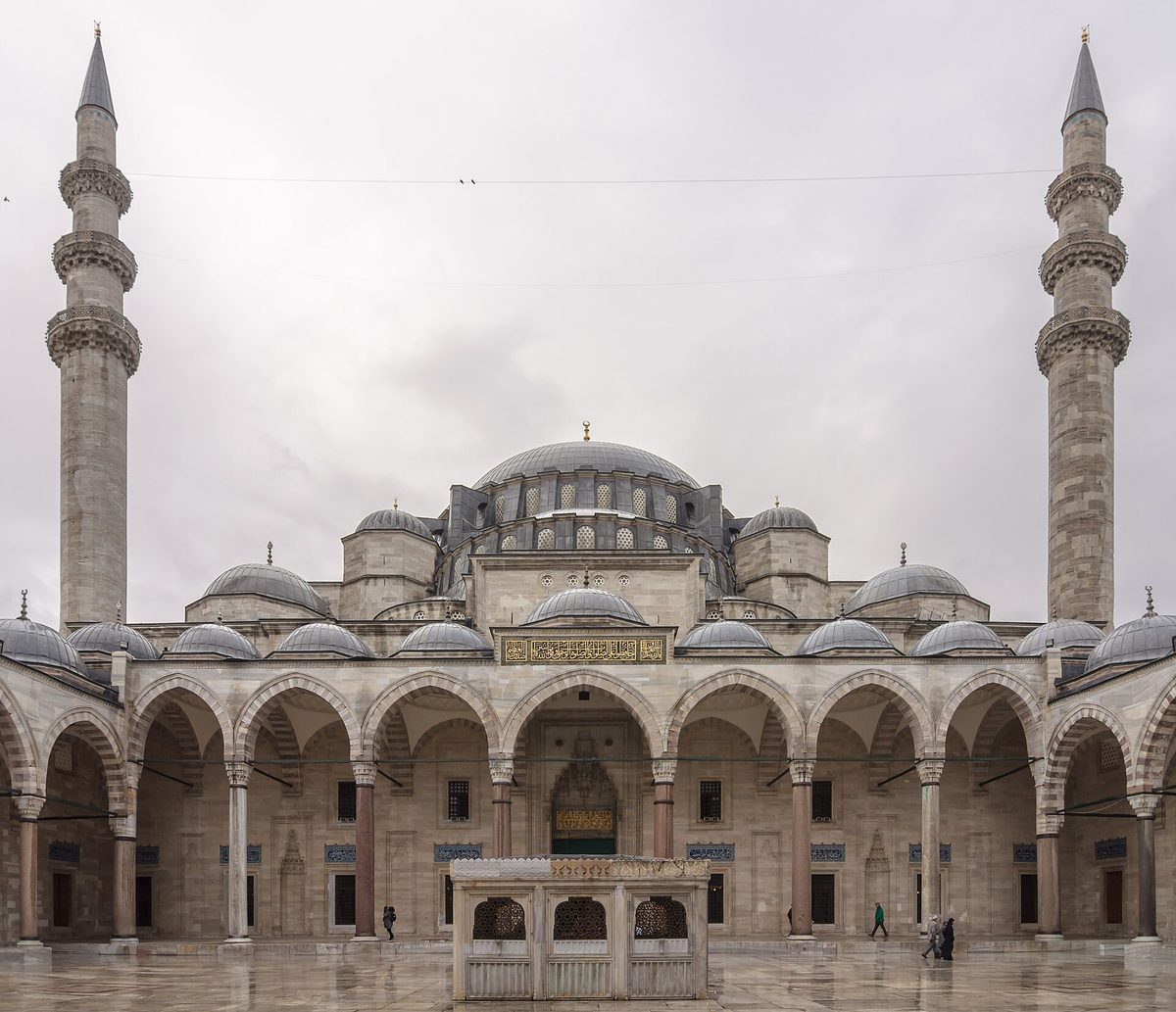
Süleymaniye Mosque, Sinan’s own masterpiece of 1557, twenty minutes uphill or three tram stops and a short climb. Free, structurally more confident than the Blue Mosque, and with a terrace over the Golden Horn to sit on afterwards. Süleyman and Roxelana are buried in the garden.
Chora, now Kariye Mosque, out by the land walls, €20, closed to tourists on Fridays. Its fourteenth-century mosaic and fresco cycle is the finest late-Byzantine painting anywhere, and after the gallery route at Hagia Sophia it is a useful corrective: this is what a Byzantine interior looked like when the decoration was complete.
Frequently asked questions
Is Hagia Sophia free?
Not for foreign visitors. It is free for worshippers, who use the main prayer floor, and free for children under eight. Foreign visitors pay €25 for a separate route through the upper galleries. Before January 2024 entry was free for everyone, which is why so much older advice says otherwise.
Do I need to book Hagia Sophia tickets in advance?
In July and August, yes — it saves a queue that can run to forty minutes. Buy from ayasofyacamii.gov.tr or muze.gov.tr and nowhere else; the search results are dense with resellers charging a mark-up. From November to March you can walk up.
Does the Istanbul Museum Pass cover Hagia Sophia?
No. Nor does it cover the Basilica Cistern, Dolmabahçe or Chora. It does cover Topkapı, the Archaeology Museums and the Turkish and Islamic Arts Museum. Work out your actual list before buying any pass — the ministry’s resellers quote it at €105, while istanbul.com quotes 6,500 TL, about €115, and that gap is a currency lag rather than a different product.
Is the Blue Mosque really free?
Yes, entirely, including the courtyard and Ahmed I’s tomb. There is no ticket, no donation requirement and no charge for the loaned scarf, shoe bag or shoe rack.
What are the Blue Mosque’s opening hours?
It has visitor windows rather than opening hours: it closes for about ninety minutes around each of the five daily prayers, and those move with the sun by roughly two hours across the year. In autumn expect something like 08:30–12:15, 13:45–16:30 and 17:30–18:30. On Fridays, nothing before about 14:30. Check the Diyanet prayer times for your date.
Can women visit Hagia Sophia and the Blue Mosque?
Yes, both, with hair covered and shoulders and knees covered. Scarves are lent at the door. Women praying use a separate area; women visiting use the same visitor route as everyone else.
How long does Hagia Sophia take?
Sixty to seventy-five minutes on the gallery route, plus queueing in season. The Blue Mosque takes twenty to thirty minutes inside and ten in the courtyard. Allow half a day for the two of them plus the Hippodrome between them.
Is Hagia Sophia worth it with the scaffolding up?
For a first visit, yes. The gallery mosaics — the Deesis in particular — are the best-preserved Byzantine work in the city, and you get closer to them than the ground floor ever allowed. If you visited before 2020 and remember the main floor, the gallery-only route plus a covered dome is a poor trade for €25, and I would spend it at Topkapı or Chora instead.
Can I take photographs inside?
Yes in both, without flash, and not of people at prayer. Tripods are not welcome in either. The light in Hagia Sophia’s galleries is low and contrasty; the Blue Mosque’s interior is bright by comparison, and the courtyard after sunset is the best photograph on this square.
Which is better, Hagia Sophia or the Blue Mosque?
They are not really competitors — one is a 1,500-year-old Byzantine cathedral that has been a mosque for most of the last six centuries, the other is a 400-year-old Ottoman mosque built partly in answer to it. If you can only enter one, and the €25 matters, the Blue Mosque is free and complete while Hagia Sophia is ticketed and half-scaffolded. If money is not the constraint, Hagia Sophia is the more extraordinary room even now, and Süleymaniye is the better mosque than either.
Fitting these two around the prayer closures is easier when you can see the whole week at once: our Istanbul itineraries for one to seven days build the Friday clearance and the Tuesday and Sunday closures into each day, and include a layover plan for anyone with a long connection at the airport.
The other great ticket on this square is four minutes away and needs a morning of its own: our guide to Topkapi Palace and the Ottoman palaces sets out what the 2,750 TL combined ticket covers, why the Harem is the part to do first, and which palace to choose if you only have time for one.
When you have had your fill of Byzantium, the walk across Galata Bridge takes twenty minutes and lands you in a completely different city: Genoese lanes, nineteenth-century arcades and the best eating in Istanbul. Our guide to Beyoğlu, Galata and Karaköy walks the district downhill from Taksim to the water.
If the gallery mosaics here leave you wanting more, the answer is forty minutes up the Golden Horn: Chora, now the Kariye Mosque, holds the most complete cycle of late Byzantine mosaics anywhere, at arm’s length, for €20 — closed to tourists on Fridays. Our guide to Balat, Fener and the Golden Horn covers Chora alongside the Patriarchate, the Iron Church and Pierre Loti hill.
One thing worth knowing before you plan a museum-heavy day around here: no version of the Istanbul Museum Pass covers Hagia Sophia. Our Museum Pass guide covers what the pass does and doesn’t include, and whether it is worth buying at all.
Related Istanbul guides
- Everything else within eight minutes’ walk is in our guide to Sultanahmet and the historic peninsula, with the same dated prices and closed days.
- For the whole city rather than the old town, see the best things to do in Istanbul, ranked across every neighbourhood.
Photo credits
- Hagia Sophia nave from the upper gallery (featured image) — photo by Jorge Láscar from Australia, Wikimedia Commons, CC BY 2.0.
- Hagia Sophia exterior — photo by Berlinaut, Wikimedia Commons, CC BY-SA 4.0.
- Hagia Sophia dome interior — photo by Sonse, Wikimedia Commons, CC BY 2.0.
- The Deesis mosaic — photo by Maksym Kozlenko, Wikimedia Commons, CC BY-SA 4.0.
- Blue Mosque courtyard at dusk — photo by Benh Lieu Song, Wikimedia Commons, CC BY-SA 3.0.
- Blue Mosque interior — photo by Russ, Wikimedia Commons, CC BY 2.0.
- Blue Mosque painted dome — photo by Bjørn Christian Tørrissen, Wikimedia Commons, CC BY-SA 3.0.
- Süleymaniye Mosque — photo by Myrabella, Wikimedia Commons, CC BY-SA 3.0.
Prices and hours checked on 10 September 2026, converted at €1 ≈ 56 TL, $1 ≈ 48 TL and £1 ≈ 65 TL. Euro-denominated state museum tickets are stable; prayer times and therefore visitor windows shift by around two hours across the year, so confirm the day’s times with the Diyanet before you set out.