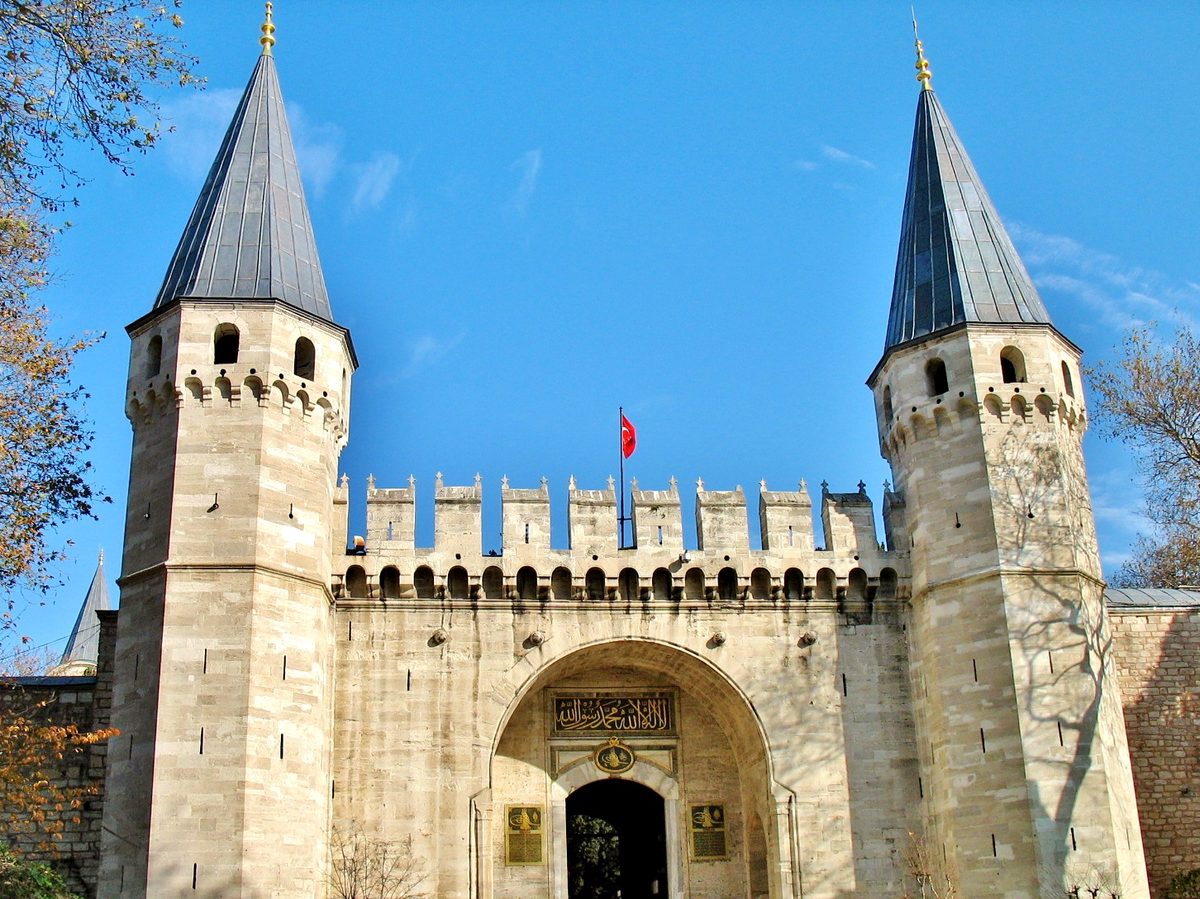
I have watched three separate groups arrive at the Gate of Salutation on a Tuesday, photograph the closed door, and stand there recalculating their day. Topkapı shuts on Tuesdays and takes the Harem and Hagia Irene down with it, and there is no version of an Istanbul itinerary that survives finding this out on the pavement. It is the single most consequential closed day in the city.
Topkapi Palace costs 2,750 TL for the combined ticket covering the palace, the Harem and Hagia Irene, opens 09:00–18:00 with last entry at 17:00, and is closed on Tuesdays. Allow three hours. Dolmabahçe, its nineteenth-century replacement on the Bosphorus, is 2,000 TL and closed on Mondays.
This guide covers all the Ottoman palaces a visitor might reasonably see — Topkapı in detail, Dolmabahçe, Beylerbeyi, and the ones that are closed or not worth the trip — with September 2026 prices, what each ticket does and does not include, how long to give them, and which to choose if you only have time for one. I have done all of them, and one of them I would not do again.
Topkapi Palace and the other palaces: prices and hours
Checked on 10 September 2026, at €1 ≈ 56 TL, $1 ≈ 48 TL and £1 ≈ 65 TL. Note the split: ministry museums quote foreign-visitor prices in euros, while the National Palaces directorate — which runs Dolmabahçe and Beylerbeyi — prices in lira, which is why those two figures drift upward through the year and the euro ones do not.
| Site | Adult price | Hours | Closed | Museum Pass | Time needed |
|---|---|---|---|---|---|
| Topkapı + Harem + Hagia Irene | 2,750 TL (~€49) | 09:00–18:00, last entry 17:00 | Tuesdays | Yes | 3 hours |
| Harem alone | 1,050 TL (~€19) | As above | Tuesdays | Yes | 45 min |
| Hagia Irene alone | 1,050 TL (~€19) | As above | Tuesdays | Yes | 30 min |
| Under 6 at Topkapı | Free | ||||
| Dolmabahçe (all sections) | 2,000 TL (~€35) | 09:00–17:30, last entry 17:00 | Mondays (one source adds Thursday) | No | 2 hours |
| Beylerbeyi Palace | 800 TL (~€14) | Daytime | Mondays | Yes | 1 hour |
| Gülhane Park | Free | Daylight hours | Never | n/a | 30 min |
| Yıldız Palace | — | Closed | — | — | — |
| Istanbul Archaeology Museums | €15, under 12 free | 09:00–18:30 | — | Yes | 90 min |
The Dolmabahçe ticket includes the Selamlık, the Harem, the Collections and an audio guide, which is unusual and good value by comparison. Photography is not permitted inside Dolmabahçe at all, which surprises people who have queued for an hour.
Topkapı Palace: what the ticket buys

Mehmed II began building here in 1459, six years after taking Constantinople, and the Ottoman court ran the empire from this hill for roughly four hundred years until it moved to Dolmabahçe in 1856. It is not a palace in the European sense — no grand staircase, no single monumental facade — but a walled compound of courtyards, pavilions and gardens, arranged so that each successive space is more private than the last.
Understanding that layout is what makes the visit work.
The first courtyard
Effectively a public park, entered free through the Imperial Gate beside Hagia Sophia. Hagia Irene stands in it. So does the Archaeology Museums complex, which is a separate ticket. The palace proper begins at the ticketed Gate of Salutation, the one with the two conical towers, where everyone but the sultan had to dismount.
The second courtyard
The administrative heart: the Imperial Council chamber where the divan met, the Tower of Justice above it, and the palace kitchens along the right-hand side — ten domed halls that once fed four thousand people a day and now hold one of the world’s great collections of Chinese porcelain, accumulated because Ottoman court medicine held that celadon changed colour in the presence of poison.
The Harem entrance is off this courtyard, and it is a separate turnstile even with the combined ticket.
The third courtyard
Through the Gate of Felicity into what was the sultan’s private household. The Audience Chamber, the library of Ahmed III, the imperial costume collection, and the two rooms everyone queues for: the Treasury, with the Topkapı Dagger and the eighty-six-carat Spoonmaker’s Diamond, and the Chamber of the Sacred Relics, which holds objects attributed to the Prophet Muhammad and is a place of devotion rather than display — a Koran reciter has been continuously present for centuries. Be quiet in it and do not photograph.
The treasury queue is the bottleneck of the whole palace. At nine in the morning it is a few minutes. At eleven it is thirty and moving at a shuffle.
The fourth courtyard
Terraced gardens on the edge of the hill, with the Baghdad and Revan kiosks, the marble terrace and the gilded İftariye canopy, looking down at the Golden Horn and the Bosphorus. This is where the visit stops being an exercise and becomes a pleasure. There is a café. Sit down.
The Harem
Three hundred rooms of which perhaps twenty are open, and the best part of the palace by a distance. This was the private residence of the sultan, his mother — the valide sultan, frequently the most powerful person in the empire — his consorts, children and the eunuchs who ran it. The tile work here is sixteenth and seventeenth-century İznik at its peak and you can stand a foot from it, which you cannot in the Blue Mosque.
Do the Harem first, at opening, before the treasury queue builds. It is the one part of the palace where being early transforms the experience.
Hagia Irene
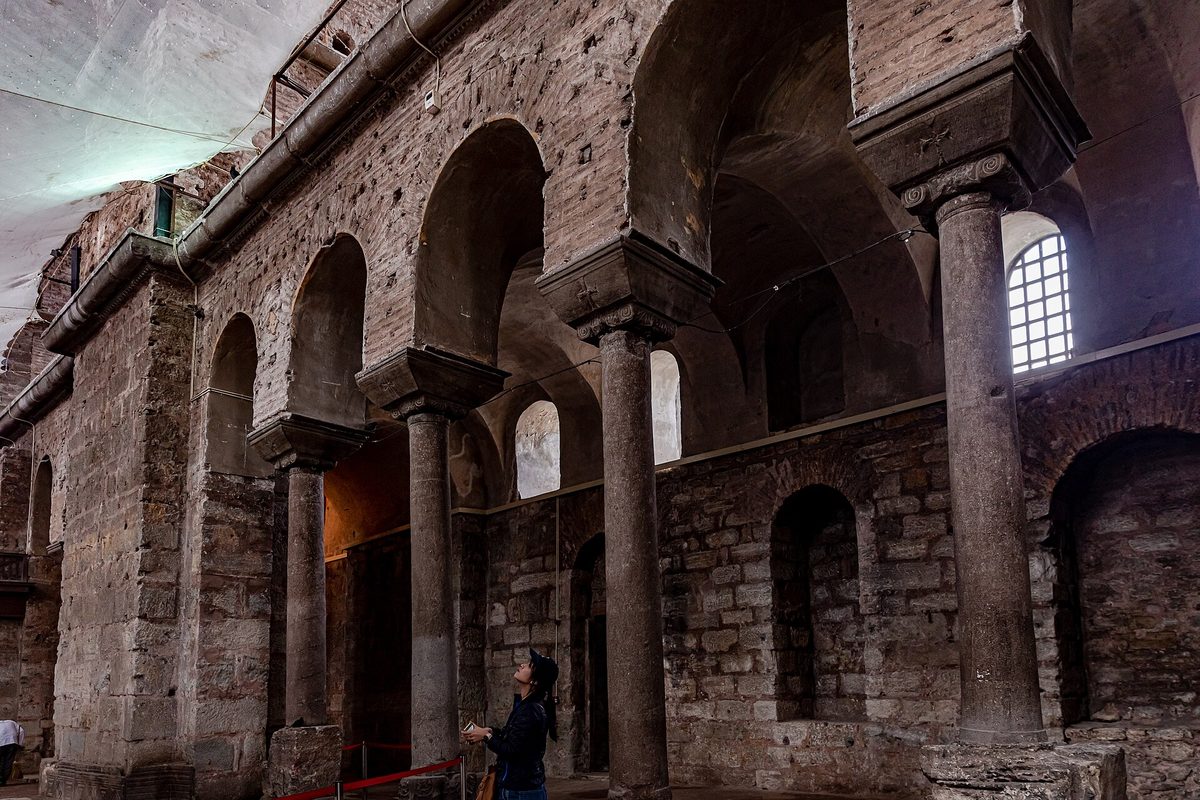
A sixth-century Byzantine church in the first courtyard, on the site of a much older one, and the only major church in the city never converted into a mosque — it was absorbed into the palace as an armoury instead. The interior is bare brick and stone with a mosaic cross in the apse, no decoration, extraordinary acoustics, and it is used for concerts during the Istanbul Music Festival in June.
It is included in the combined ticket, it takes half an hour, and a striking number of people with the ticket in their pocket never go in.
Who actually lived here
The palace makes far more sense once you know that it was not primarily a residence. It was a government building, a treasury, a school and a household, containing at its height several thousand people, most of whom never left.
The sultan occupied the innermost courtyards and was, by design, almost invisible. Foreign ambassadors were received in the Audience Chamber having walked through two courtyards in enforced silence, past janissaries who did not acknowledge them, to find the sultan seated and often not speaking at all. The theatre was the message.
The valide sultan — the sultan’s mother — ran the Harem and, through much of the sixteenth and seventeenth centuries, a good deal of the empire. The period historians call the Sultanate of Women, when successive valide sultans and consorts held decisive political power, is not a footnote here: it is what the Harem’s layout, with the valide’s apartments at the centre of the complex, was built to accommodate.
Hürrem Sultan — Roxelana in European sources — was the first consort to be formally married to a sultan and the first to live permanently inside the palace, which broke several centuries of precedent and reshaped the court. She is buried beside Süleyman at Süleymaniye, twenty minutes up the hill.
The princes. Early Ottoman succession law permitted a new sultan to have his brothers killed, which is why the tomb of the princes beside Hagia Sophia contains so many small sarcophagi. From the seventeenth century the practice was replaced by the kafes, the “cage” — a set of apartments in the Harem where potential heirs were confined, sometimes for decades. Several sultans arrived on the throne having spent their entire adult lives in three rooms, and it shows in the historical record.
The palace school in the third courtyard trained the empire’s administrators, drawn largely from the devşirme levy of Christian boys from the Balkans, who converted, were educated here and could rise to grand vizier. A striking proportion of the men who ran the Ottoman state were born outside it.
The court left for Dolmabahçe in 1856. Topkapı became a museum by decree in 1924, one of the first acts of the new republic, which is why it is a state museum rather than a National Palaces property and why the Museum Pass covers it while Dolmabahçe is a separate ticket.
Things most visitors walk straight past
The Executioner’s Fountain, just outside the Gate of Salutation, where the palace executioner is said to have washed his hands and his sword. Unmarked, unremarkable to look at, and the sort of detail that changes how the courtyard feels.
The porcelain marks. In the kitchens, look at the bases of the celadon pieces: many carry inventory marks scratched by palace stewards, which is how the collection can be dated so precisely. Roughly ten thousand pieces survive, the largest such collection outside China.
The Topkapı Dagger’s story. Made in 1747 as a gift from Mahmud I to Nader Shah of Persia, it never arrived — the shah was assassinated while the delegation was still travelling, and the gift came home. It has been here ever since, and it is the object the 1964 film was named after.
The Spoonmaker’s Diamond, eighty-six carats, surrounded by forty-nine smaller stones, with an origin story involving a fisherman, a rubbish heap and a spoon-maker who traded it for three spoons. Almost certainly untrue and universally repeated.
The Tower of Justice, the tallest structure in the palace, from which the sultan could listen unseen to the Imperial Council through a grilled window — a piece of architecture designed entirely around the idea that the ruler might be watching.
The cats. Istanbul’s street cats are a civic institution and Topkapı’s are the aristocracy of them. They are fed, they are unbothered, and they sleep on four-hundred-year-old marble.
Gülhane Park, below the palace walls, was the outer garden of the whole complex and is now a free public park with tulips in April. It is the correct place to sit down after three hours on gravel.
Getting there and fitting it into the day
The T1 tram stops at Gülhane, two minutes from the palace’s outer wall, and at Sultanahmet, about eight minutes from the Gate of Salutation. A standard ride is 46.20 TL on an Istanbulkart. From the Asian side, take a ferry to Eminönü and one stop on the tram; from Beyoğlu, walk over Galata Bridge and pick up the tram at Eminönü.
There is airport-style security at the entrance and large luggage is not permitted, with no cloakroom worth the name, so do not arrive straight from a station.
The day that works: Topkapı at nine, three hours; the Archaeology Museums in the first courtyard on the way out, ninety minutes; lunch at Hocapaşa near Sirkeci; then the Basilica Cistern or the Turkish and Islamic Arts Museum in the afternoon. That is a full and coherent day, and it leaves Hagia Sophia and the Blue Mosque for a separate morning, which is how they should be done.
For Dolmabahçe: tram to Kabataş and five minutes on foot, or ferry to Beşiktaş and ten. Combine it with Ortaköy, the Bosphorus shore and Beşiktaş market rather than with anything in the old city — they are forty minutes apart and belong to different days.
How to do Topkapı properly

Go at 09:00, not a Tuesday. The palace opens at nine and the coach groups arrive around ten. That first hour is worth more than any other planning decision here.
Harem first, treasury second, kitchens third. This is the reverse of what most people do and it works precisely because of that.
Buy the combined ticket. At 1,050 TL each for the Harem and Hagia Irene separately, the 2,750 TL bundle pays for itself the moment you want two of the three, and there is no scenario in which you should skip the Harem.
Book online in July and August, from muze.gov.tr, and be careful which site you are on — a large share of the search results for Topkapı tickets are resellers charging a mark-up.
Three hours minimum, four if you like museums. People routinely allot ninety minutes and see a third of it.
Wear shoes you can walk on gravel in. The site is large, largely outdoors and involves a good deal of standing.
Do not try to do Hagia Sophia and Topkapı properly in the same morning. Both need their own run at the day. Hagia Sophia at eight, Topkapı the following morning at nine, is the arrangement that works.
Dolmabahçe Palace
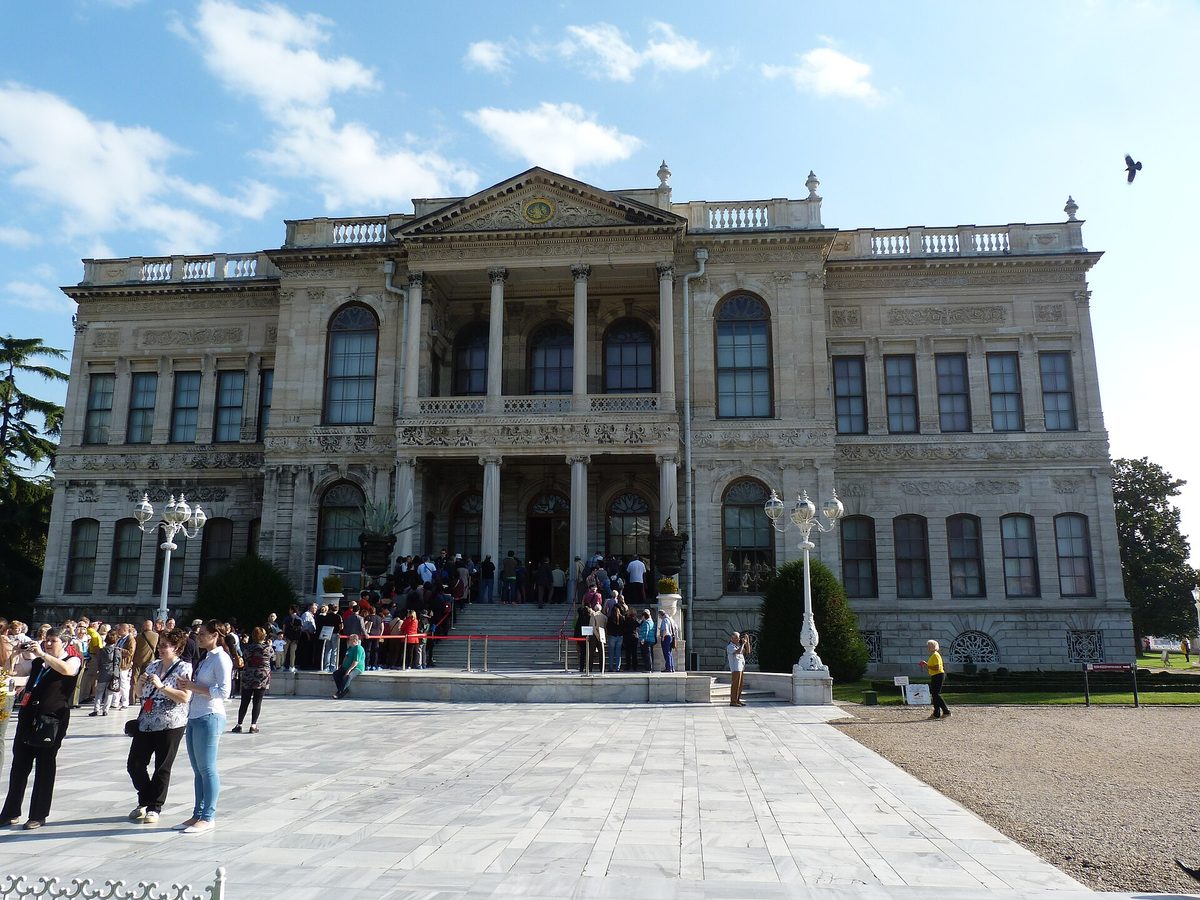
Built between 1843 and 1856 for Abdülmecid I, and the point of it was to demonstrate that the Ottoman empire was a modern European power. It is enormous, European in style, extravagantly furnished, and it was paid for with foreign loans that contributed to the state defaulting twenty years later. That context is what makes the building interesting rather than merely opulent.
What you get for 2,000 TL: the Selamlık, the state apartments, the Harem, the Collections, and an audio guide. Highlights are the Crystal Staircase, with balusters of Baccarat crystal; the Ceremonial Hall under a 36-metre dome with a four-and-a-half-tonne chandelier given by Queen Victoria; and the room where Atatürk died on 10 November 1938, its clock stopped at 09:05, which is still marked with a minute’s silence across Turkey each year.
Closed Mondays, and one source adds a Thursday closure, so check millisaraylar.gov.tr for your dates before travelling out there. Not covered by the Museum Pass, since the National Palaces run their own ticketing. No photography inside. Allow two hours including the queue, which in season is real.
Getting there: the T1 tram to Kabataş and a five-minute walk, or a ferry to Beşiktaş and ten minutes along the shore. The exterior from the water — on any Bosphorus ferry or cruise — is arguably the better view of it, and free.
Beylerbeyi Palace

On the Asian shore directly under the first Bosphorus bridge, a summer palace built in the 1860s for Abdülaziz and used for entertaining visiting heads of state — the Empress Eugénie of France stayed here, and so, much later and much less willingly, did the deposed Abdülhamid II, who spent his last years under house arrest in it.
800 TL, closed Mondays, covered by the Museum Pass, and it takes an hour. It is smaller, less crowded and in some ways more likeable than Dolmabahçe: the same nineteenth-century Ottoman-European style at a scale you can absorb, with Egyptian reed matting under the carpets and a marble pool in the main hall.
Worth combining with a Bosphorus ferry day or a trip up the Asian shore rather than made a special journey.
The palaces you cannot see, and the ones not worth it
Yıldız Palace, Abdülhamid II’s fortified compound above Beşiktaş, is closed. The park around it is open and pleasant, and the Yıldız Hamidiye Mosque below it is worth a look on the way past.
The Great Palace of the Byzantine emperors survives only in fragments — the mosaic floors preserved at the Great Palace Mosaic Museum behind the Blue Mosque, which is itself closed for restoration with no announced reopening date. If you find the Arasta Bazaar gate open, go straight in; it means the works have finished.
Küçüksu Pavilion and the Aynalıkavak Pavilion are small National Palaces properties, pleasant and very minor. Skip unless you are a specialist or they are on your route.
“Ottoman palace experience” dinners and shows. Not palaces. Not Ottoman in any meaningful sense.
Visiting with children, and in bad weather
With children. Topkapı is better for them than most historic houses, because it is largely outdoors and because the treasury and the armoury contain exactly the sort of objects children want to look at — daggers, thrones, an eighty-six-carat diamond. What does not work is the queue for the treasury and the length of the whole thing. Do the Harem and the fourth-courtyard terraces, look at the kitchens, skip anything with a line, and finish in Gülhane Park below the walls, which is free, shaded and has room to run. Under-sixes go in free.
In the rain. This is the weakness. Topkapı is a compound of separate buildings connected by open courtyards, so a wet day means repeated dashes between exhibits, and the covered sections are the ones with queues. If the forecast is bad, swap it for Dolmabahçe — a single building you walk through under a roof — or the Archaeology Museums, and keep the palace for a dry morning.
In summer. The courtyards are largely unshaded and the marble reflects heat. The nine o’clock opening is not just about crowds in July and August; by noon the second courtyard is genuinely uncomfortable. Carry water — there are fountains and a café — and use the fourth courtyard’s trees.
Where the palace’s contents ended up
One thing worth knowing before you decide how long to spend: a good deal of what a visitor imagines is inside Topkapı is not, or is not on display, and several of the palace’s most interesting collections live elsewhere in the city.
The Archaeology Museums, inside Topkapı’s own first courtyard, hold the Alexander Sarcophagus, the Treaty of Kadesh and a section of the Ishtar Gate. €15, covered by the Museum Pass, and it is the single best collection on the peninsula. Parts of it have been in phased renovation for years, so ask at the desk which buildings are open.
The Museum of Turkish and Islamic Arts, on the Hippodrome, holds the carpets, the Seljuk fragments and the manuscript collection — the material culture of the empire, rather than its jewellery. €17, Museum Pass valid.
The Harem’s tiles are the best İznik in the city that you can approach closely; the next best free version is Rüstem Paşa Mosque at Eminönü, and Sokollu Mehmet Paşa near the Hippodrome.
The imperial mosques — Süleymaniye above the Grand Bazaar, and the tombs beside Hagia Sophia — are where the sultans themselves ended up, and all of them are free. If Topkapı has left you curious about the dynasty rather than the objects, that is where to go next, and it costs nothing.
Which palace, if you only have time for one?
Topkapı, without hesitation, on a first visit. It is older, stranger, more revealing about how the empire actually worked, and the Harem and the fourth-courtyard terraces are things you will not see anywhere else. The 2,750 TL is the most defensible large ticket in Istanbul.
Dolmabahçe if you have seen Topkapı, or if nineteenth-century interiors are your interest, or if you want the Atatürk connection. It is a European palace that happens to be in Istanbul, which is either the point or the problem depending on what you came for.
Beylerbeyi if you are spending a day on the Bosphorus anyway and want something to walk into. At 800 TL and an hour, it asks very little.
Neither, and spend the money on the Archaeology Museums and the Turkish and Islamic Arts Museum, if what you actually like is objects rather than rooms. €32 for the pair, both covered by the Museum Pass, and between them a better collection than either palace.
The Museum Pass question
The Museum Pass İstanbul covers Topkapı, the Harem, Hagia Irene, Beylerbeyi, the Archaeology Museums, the Turkish and Islamic Arts Museum and Rumeli Hisarı. It does not cover Hagia Sophia, the Basilica Cistern, Dolmabahçe or Chora — which is, unhelpfully, the exact list most first-time visitors have written down.
It runs five days, or 120 hours, from first use, across thirteen sites. The price is quoted at €105 by the ministry’s resellers and at 6,500 TL, about €115, by istanbul.com; that difference is a currency lag rather than two different products, but check which currency you are actually being charged in.
The arithmetic is straightforward. Topkapı at 2,750 TL is roughly €49, the Archaeology Museums €15, the Turkish and Islamic Arts Museum €17, Beylerbeyi about €14, Rumeli Hisarı €6. Four of those get you to about €95, so the pass starts paying at four or five sites used inside five days. If your list is Hagia Sophia, the cistern and Topkapı, it saves you nothing at all.
Be careful about which site you buy from, too. There are lookalike domains selling passes at a mark-up; muze.gov.tr is the ministry’s own.
Frequently asked questions
How much is a Topkapi Palace ticket?
2,750 TL, about €49, for the combined ticket covering the palace, the Harem and Hagia Irene. The Harem and Hagia Irene are 1,050 TL each on their own. Under-sixes are free. It is covered by the Museum Pass İstanbul. Checked 10 September 2026.
Is Topkapi Palace closed on Tuesdays?
Yes, every Tuesday, and the closure takes the Harem and Hagia Irene with it. This is the single most itinerary-breaking fact in Istanbul, and it catches people every week.
How long do you need at Topkapi Palace?
Three hours as a minimum and four if you like museums. That covers the four courtyards, the Harem, the treasury, the kitchens and Hagia Irene at a pace that includes sitting down in the fourth courtyard, which you will want to do.
Is the Harem worth the extra?
Yes, and it is the best part of the palace. With the combined ticket it is not really an extra at all, since buying the Harem and Hagia Irene separately costs 2,100 TL against 2,750 TL for everything. Do it first, at opening.
Which is better, Topkapi or Dolmabahçe?
Topkapı, for a first visit — older, more unusual, and far more revealing about how the Ottoman state functioned. Dolmabahçe is a nineteenth-century European palace and a spectacular one, but it tells you about the empire’s last decades rather than its height. If you have time for both, do Topkapı first.
Do I need to book Topkapi Palace in advance?
In July and August it saves a genuine queue; book from muze.gov.tr rather than the resellers that dominate the search results. From November to March you can walk up. Note that last entry is 17:00 and enforced.
Can you take photographs inside?
At Topkapı, yes in most areas, without flash, and not in the Chamber of the Sacred Relics. At Dolmabahçe, no photography inside at all. At Beylerbeyi, restrictions vary — ask at the door.
Is there a dress code for Topkapi Palace?
No, it is a museum rather than a place of worship. Modest clothing is polite in the Chamber of the Sacred Relics, and if you are combining the palace with Hagia Sophia or the Blue Mosque on the same day you will need shoulders and knees covered and a scarf for those.
Is Topkapi Palace accessible?
Partially. The site is large, spread over four courtyards with gravel underfoot, cobbled slopes and steps between several sections, and the Harem in particular involves stairs. There are accessible routes to some areas; the palace is honest about the limits, and Dolmabahçe and the Archaeology Museums are considerably flatter alternatives.
Can you visit Topkapi Palace without a guide?
Yes, and most people should. The labelling is bilingual and adequate, the site has an audio guide, and the layout explains itself once you understand the courtyard sequence. A licensed private guide for a half-day is genuinely worthwhile if you want the political history rather than the object list, but the two-hour group tours sold on the square are largely a way of paying extra to be walked past the same rooms in a crowd.
Is Hagia Irene included in the Topkapi ticket?
In the 2,750 TL combined ticket, yes. It is also sold separately at 1,050 TL, and it is covered by the Museum Pass. It stands in the free first courtyard, which means you can walk up to it without a ticket and only need one to go inside. A lot of people with the combined ticket never do, which is a waste of a genuinely remarkable building.
How much does it cost to visit all the Istanbul palaces?
Topkapı with the Harem and Hagia Irene is 2,750 TL, Dolmabahçe 2,000 TL and Beylerbeyi 800 TL — about 5,550 TL, roughly €99, at September 2026 prices. A Museum Pass at €105 covers Topkapı and Beylerbeyi but not Dolmabahçe, so it only makes sense if you are also using several of the other covered museums within the five-day window.
What else is near Topkapi Palace?
Hagia Sophia is four minutes away, the Archaeology Museums are inside the first courtyard, Gülhane Park is below the walls and free, and the Blue Mosque, the Hippodrome and the Basilica Cistern are all within ten minutes’ walk. It is the densest square kilometre of sights in Europe and it is entirely walkable.
Tuesday at Topkapı is only one of four closed days that quietly wreck first itineraries, and the mosque visiting windows move with the sun all year. Our guide to the things to know before visiting Istanbul collects all of them in one table, along with the taxi tariff, the Istanbulkart arithmetic and the scams you are most likely to meet.
The other tower everybody photographs is across the Golden Horn and costs €30 with a queue capped at a hundred people an hour — our Beyoğlu and Galata guide gives an honest verdict on whether Galata Tower is worth it, plus İstiklal’s passages, Karaköy and the Pera museums.
If your plan collapses on a Tuesday, the bazaar quarter is the obvious fallback — and the reverse is true on Sundays, when Topkapı is open and the Grand Bazaar is not. Our guide to the Grand Bazaar and the Spice Bazaar sets out the hours, gates, haggling rules and the sights in between.
Topkapı is the single strongest inclusion on the Istanbul Museum Pass, covering the palace, the Harem and Hagia Irene together. Our Museum Pass guide works out whether the pass actually pays for itself against your own itinerary.
Related Istanbul guides
- Everything else within ten minutes’ walk is in our guide to Sultanahmet and the historic peninsula.
- The other great monument on the same square: Hagia Sophia and the Blue Mosque, with tickets, hours and the dress code.
- Where a palace morning fits in the week is set out in our Istanbul itineraries for one to seven days.
- Dolmabahçe and Beylerbeyi look best from the water — see our Bosphorus cruise guide.
- And for reaching all of them, getting around Istanbul.
Photo credits
- The Gate of Salutation at Topkapı Palace (featured image) — photo by Kyle Magnuson, Wikimedia Commons, CC BY 2.0.
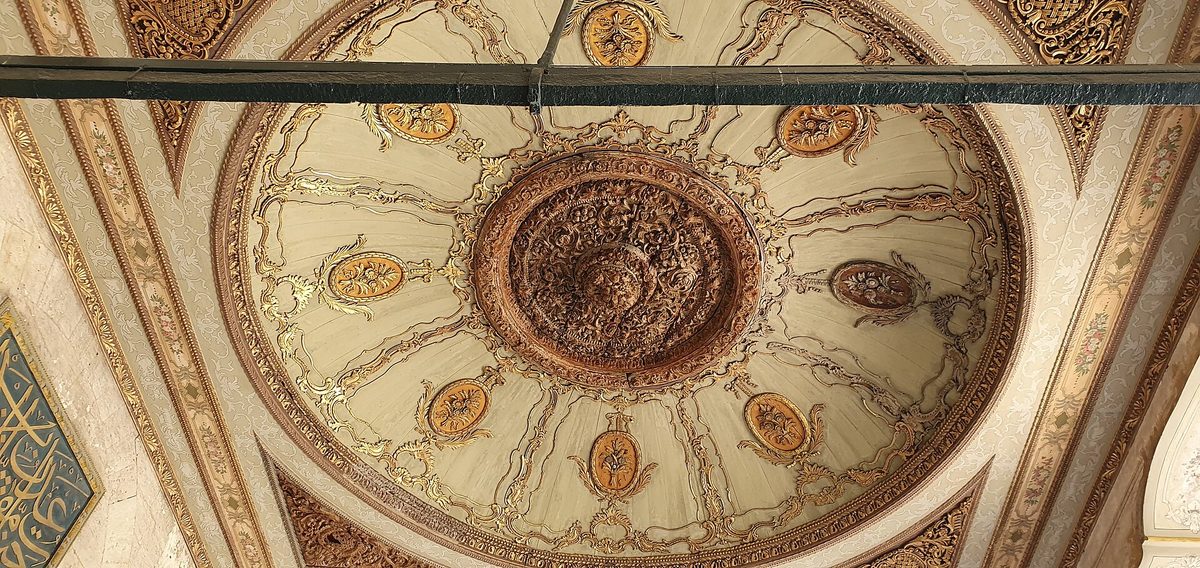
- Ceiling of the Gate of Salutation — photo by Yair Haklai, Wikimedia Commons, CC BY-SA 4.0.
- The Baghdad Kiosk — photo by Moonik, Wikimedia Commons, CC BY-SA 3.0.
- Hagia Irene interior — photo by Ninara, Wikimedia Commons, CC BY 2.0.
- Hagia Sophia — photo by Berlinaut, Wikimedia Commons, CC BY-SA 4.0.
- Dolmabahçe Palace facade — photo by Derzsi Elekes Andor, Wikimedia Commons, CC BY-SA 4.0.
- Şehir Hatları ferry — photo by Mark Ahsmann, Wikimedia Commons, CC BY-SA 3.0.
Prices and hours checked on 10 September 2026, converted at €1 ≈ 56 TL, $1 ≈ 48 TL and £1 ≈ 65 TL. Lira-priced National Palaces tickets drift upward through the year while euro-priced ministry tickets do not; closed days at Dolmabahçe are reported inconsistently, so confirm at millisaraylar.gov.tr before making a special trip.